Recommended Books
Every book on this page was recommended at the end of a courben.co article. Reading about a psychological concept is one thing — having a book that lets you live inside it is another. These recommendations exist because an article should leave you with something you can act on, not just something you can recall. The difference between forgettable and memorable is almost always what you do next.
This page contains affiliate links. If you purchase through our links we may earn a small commission at no extra cost to you. We only recommend books we genuinely believe extend the psychology explored in our articles.
Showing 247 books
Hillbilly Elegy
Article #251
The psychology of being the first entrepreneur in your family — and why success can feel like a form of betrayal
Hillbilly Elegy by J.D. Vance is the most widely read insider account of the first-generation social mobility experience — the between-world belonging, the survivor guilt, the betrayal perception, and the specific ways that the cultural capital gap produces the faking-it dynamic in practice. Vance's account is not a triumph narrative; it is an honest account of the psychological cost of moving between worlds, written by someone who had made the move and was still reckoning with what it meant. For the first-generation entrepreneur who recognises the between-world experience but has not had access to language for it, this book provides that language more directly than the academic literature that formally documents the same mechanisms.
Daring Greatly
Article #250
Why the fear of outgrowing your social circle is one of the most suppressed barriers to entrepreneurial growth
Daring Greatly by Brené Brown. Previously recommended in this series. Brown's research on the specific courage required for visibility — and the shame response that suppresses it — is the most direct available account of the psychological experience of being visible at levels that exceed the origin group's norm. Her distinction between fitting in (suppressing difference to maintain group membership) and belonging (being genuinely seen and accepted, difference included) maps precisely onto the outgrowing dilemma the article describes. Educated by Tara Westover. Westover's memoir of intellectual and educational upward mobility from an origin community that could not follow her — and the psychological cost and meaning of that navigation — is the most emotionally precise account available of what the outgrowing experience feels like from the inside. It does not offer solutions; it offers recognition, which is often what the entrepreneur who is silently managing this tension most needs to find.
Mind Over Money
Article #249
How your friendship group's collective attitude toward money quietly shapes your pricing psychology
Mind Over Money by Brad Klontz and Ted Klontz is the most accessible account of the money scripts research and its application to real financial decision-making. Klontz spent years applying the money scripts framework in clinical and research contexts, and the book makes the research accessible without losing its precision. For the entrepreneur who recognises the discomfort-at-pricing pattern and wants to understand where it comes from and how to work with it rather than simply override it, this is the most direct available resource. It does not assume a psychology background and it does not offer motivational reframing as a substitute for understanding the mechanism.
The Status Game
Article #248
The psychology of social comparison among peers — why watching friends succeed in careers you chose not to pursue creates specific entrepreneurial distortions
The Status Game by Will Storr is the most psychologically rigorous popular account of how status comparison shapes human behaviour and strategic choice. Storr's treatment of the neural pain of status loss, the automatic nature of comparison responses, and the specific ways that status-seeking distorts decision-making is directly applicable to the peer comparison mechanism this article describes. The book is not reassuring — it does not offer a way to stop making comparisons — but it provides the most honest available account of why the comparisons produce the responses they do, which is the necessary precondition for making strategic decisions independently of those responses.
Reinventing Your Life
Article #247
How parental expectations operate as invisible business partners in every strategic decision you make
Reinventing Your Life by Jeffrey Young and Janet Klosko. Young's schema therapy framework identifies the specific patterns that childhood relational experiences install as adult operating templates — including the demanding standards schema and the subjugation schema, both of which are direct expressions of the introjected parental standard mechanism. The book is structured around recognisable patterns rather than clinical categories, and the entrepreneur who reads it will identify their own invisible partner with unusual specificity. Awareness by Anthony de Mello. De Mello's account of how programmed responses — absorbed from family, culture, and early experience — operate as automatic filters on adult perception and choice is the most accessible philosophical treatment of what the SDT introjection research establishes empirically. For the entrepreneur who wants to understand what it means to make a decision that is genuinely their own rather than a response to an internalised program, this is the clearest available account of what that distinction actually involves.
The Other Side of Sadness
Article #246
The Other Side of Sadness by George Bonanno. Bonanno's account of the resilience trajectory — and his challenge to the cultural assumption that grief must be prolonged and incapacitating to be genuine — is the most important corrective to the grief-as-barrier assumption that many entrepreneurs bring to their own experience of loss. His research establishes that continuing to function, to build, and to pursue new directions alongside genuine grief is not avoidance or denial. For the entrepreneur who is grieving and building simultaneously and feels that they are somehow not grieving correctly, this book provides the most honest account of what the research actually shows. Working Identity by Herminia Ibarra. Ibarra's research on career reinvention — particularly her account of how identity change follows action rather than preceding it — is the most practically applicable framework for the entrepreneur using loss as a moment of genuine directional reconstruction.
Outliers
Article #246
How the people you spend the most time with set the psychological ceiling on your ambition without either of you realising
Outliers by Malcolm Gladwell. Gladwell's account of how social context — birth cohort, community, cultural environment — shapes opportunity and outcome is the most accessible popular synthesis of the peer effect and social environment research. It is deliberately illustrative rather than technically rigorous, which makes it a useful companion to the Christakis and Fowler research: where Connected provides the mechanism, Gladwell provides the narrative texture of what the mechanism looks like at scale across different domains and contexts. Daring Greatly by Brené Brown. Previously recommended in this series. Brown's account of the belonging anxiety that suppresses vulnerability — and by extension, the ambition that requires vulnerability to pursue — is the most direct treatment available of the internal ceiling that the fear of outgrowing one's social group produces. Her research on the relationship between belonging and worthiness is directly applicable to the self-suppression mechanism that social mobility anxiety produces.
Generation to Generation: Life Cycles of the Family Business
Article #245
The psychology of family businesses — why the family system's dysfunction becomes the organisation's dysfunction
Generation to Generation: Life Cycles of the Family Business by Kelin Gersick, John Davis, Marion Hampton McCollom and Ivan Lansberg is the most comprehensive research-based account of how family businesses develop, fail, and occasionally thrive across generational transitions. The book maps the overlapping systems — family, ownership, and business — and documents with clinical precision how the emotional dynamics of each system create the governance challenges that family business practitioners consistently encounter. For the entrepreneur in a family business trying to understand why normal management interventions are not producing normal management outcomes, this book provides the most complete diagnostic framework available. It is rigorous without being inaccessible, and it treats the family system's influence on organisational behaviour with the seriousness the research supports.
Frientimacy
Article #244
How becoming successful financially changes your existing friendships in ways nobody warns you about
Frientimacy by Shasta Nelson. Nelson's research-grounded framework for understanding what genuinely sustains adult friendships — her three requirements of positivity, consistency, and vulnerability — maps directly onto the friendship mechanisms that financial divergence disrupts. The book provides practical vocabulary for identifying which friendships have the relational infrastructure to survive significant life change and which were always more situationally maintained than genuinely intimate. For the entrepreneur navigating which pre-success friendships are worth the deliberate maintenance investment that wealth divergence makes necessary, this is the most practically useful book available. Lost Connections by Johann Hari. Hari's account of what genuine connection actually requires — shared meaning, mutual vulnerability, authentic self-disclosure — is the most readable treatment of why the concealment strategy that protects friendships from comparison pain simultaneously prevents them from providing what friendship is for. His argument that connection requires being genuinely known, not carefully curated, applies with specific precision to the financial success concealment dynamic that this article describes.
Hardwiring Happiness
Article #243
The psychology of building a business to prove something — and what happens when you succeed
Hardwiring Happiness by Rick Hanson. Hanson's account of why the brain fails to sustain the emotional impact of achieved goals — the negativity bias, the hedonic treadmill, and the neurological basis of the arrival fallacy — is the most accessible scientific explanation for why proving-business success produces the emotional flatness that the entrepreneur was not expecting. Understanding the mechanism does not eliminate the experience, but it reframes it from personal inadequacy to neurological predictability, which is a more useful starting point for what comes next. Man's Search for Meaning by Viktor Frankl. Frankl's account of meaning as something discovered through engagement rather than delivered by achievement is the most enduring available treatment of the question that proving-business success leaves the entrepreneur with: what do I build toward now? His distinction between meaning pursued as a goal and meaning that emerges as a byproduct of committed engagement with something larger than the self is the most direct available prescription for the identity reconstruction task that post-proof success creates.
The Founder’s Dilemmas
Article #242
Why co-founder relationships follow the same psychological patterns as marriages — and fail for identical reasons
The Founder's Dilemmas by Noam Wasserman is the most research-grounded account of co-founder relationship dynamics available. Wasserman spent years at Harvard Business School collecting and analysing data from thousands of startups, and the book's treatment of co-founder selection, equity structure, dissolution causes, and the failure patterns that the research consistently identifies is both empirically rigorous and directly applicable. The specific finding that 65% of startups experience co-founder departure before exit — and Wasserman's detailed account of the values and communication patterns that predict which 65% — is the business case for taking the co-founder relationship as seriously as any other aspect of the venture. If you have a co-founder or are about to acquire one, this book is required reading before the conversation about equity begins.
Loneliness: Human Nature and the Need for Social Connection
The Drama of the Gifted Child
Article #239
Why your relationship with your parents determines your relationship with authority, clients, and investors
The Drama of the Gifted Child by Alice Miller is a short, precise psychodynamic account of how parental relationship patterns — particularly those built on conditional approval and the suppression of authentic feeling — are re-enacted throughout adult professional life. Miller's particular focus is on high-achieving adults whose performance is partly driven by the approval-seeking established with demanding or critical parents, and the book's account of what it costs to build a professional identity on that foundation is the clearest available treatment of the mechanism this article describes. It is not a business book and does not pretend to be — but the entrepreneur who reads it in the context of their investor and client relationships will find the clinical observations more commercially relevant than most of the business psychology literature that covers similar ground less precisely.
Wired for Love
Article #238
The psychology of the 'supportive partner who secretly resents the business' — and why both people are usually unaware it's happening
Wired for Love by Stan Tatkin. Tatkin's neurobiologically grounded account of how partners function as each other's primary regulators — and what happens to that regulatory system under sustained stress and implicit threat — is the most mechanistically precise book available on why the suppressed resentment pattern produces the vague relational unease that neither person can identify. His framework for building what he calls a "couple bubble" — a mutual security system that is robust enough to hold the stresses that entrepreneurship generates — is directly applicable to the structural intervention the resentment pattern requires. Crucial Conversations by Kerry Patterson, Joseph Grenny, Ron McMillan and Al Switzler. The research-informed communication framework for making implicit dynamics explicit — covering how to approach conversations where the stakes are high, emotions are activated, and neither person is fully aware of what they are actually communicating. For the entrepreneurial couple who recognise the resentment pattern and want to address it directly without the conversation itself becoming the next source of conflict, this book provides the most practically applicable framework available.
Tribes
Article #237
How friendship networks shrink predictably as your business grows — and the psychological cost of that isolation
Tribes by Seth Godin. Godin's short, direct account of community building as both a leadership function and an antidote to isolation is specifically useful for the entrepreneur who recognises the loneliness pattern but has not yet translated that recognition into a structural response. The book's core argument — that deliberate community is something built, not waited for — maps directly onto the EO peer forum evidence and applies regardless of industry or business stage. The Art of Gathering by Priya Parker. Parker's research-informed framework for building genuine connection through intentional design — how the structure of how people come together shapes what is possible within those encounters — is the most practically applicable book on moving from surface social contact to the relational depth that counters entrepreneurial isolation. It is not a business book, but the entrepreneur who reads it will immediately see its application to how they build and maintain the social infrastructure that the business progressively erodes.
The Achieving Society
Article #236
Why entrepreneurs who feel unseen at home seek validation from their business in ways that distort strategy
The Achieving Society by David McClelland is one of the foundational texts in the psychology of motivation, and its direct relevance here is the empirical distinction between achievement, affiliation, and recognition as motivational drivers — and the documented evidence that recognition-motivated decision-making produces measurably worse long-term business outcomes than achievement-motivated decision-making. McClelland's research was built on decades of cross-cultural data and remains among the most rigorous accounts of how motivational profile shapes business performance. For the entrepreneur who suspects their decision-making has drifted toward visibility-seeking, the achievement motivation framework provides both the diagnostic vocabulary and the evidence base for why recalibrating matters commercially, not just psychologically. This is not a self-help book; it is serious social science that happens to be directly applicable to the pattern this article describes.
The Seven Principles for Making Marriage Work
Article #235
Why the person closest to you has more influence over your entrepreneurial decisions than any business coach
The Seven Principles for Making Marriage Work by John Gottman and Nan Silver. Gottman's love maps concept — the richness of a partner's internal model of each other's aspirations, fears, and inner world — is the most directly applicable framework in this book for the entrepreneur who wants to understand why partner influence is so contextually precise. A partner with a deep love map provides feedback that is calibrated to the actual person rather than a professional presentation of them, which is why it lands differently than coaching. The book is grounded in decades of Gottman Institute research and reads practically rather than theoretically. Hold Me Tight by Sue Johnson. Johnson's emotionally focused therapy framework explains how the primary attachment relationship provides the emotional security that makes genuine risk-taking possible — the base from which an entrepreneur ventures out. For the entrepreneur who has noticed that their willingness to take business risks fluctuates with the state of their relationship and wants to understand why, Johnson's account of how attachment security functions as an enabling condition for bold action is the clearest explanation available.
I Know How She Does It
Article #235
The psychology of building a business while raising children — why guilt is the most expensive cognitive overhead you carry
I Know How She Does It by Laura Vanderkam is among the most practically useful books an entrepreneurial parent can read, and its usefulness comes from data rather than reassurance. Vanderkam conducted detailed time-use studies of high-achieving women — executives, entrepreneurs, professionals with children — and found consistently that the subjective sense of never being present enough bore little relationship to the actual time records. Entrepreneurial parents typically spend considerably more quality time with their children than their guilt suggests, because guilt calibrates to the perfectionist ideal rather than the actual picture. The book's value is in replacing a vague, guilt-fuelled self-assessment with something more accurate — and in doing so, it makes the case more convincingly than any motivational argument that the cognitive overhead of parental guilt is frequently built on a false foundation. Read it as a corrective to the internal accounting system that most entrepreneurial parents are running, and read it specifically for the time-use methodology, which is more rigorous than the genre usually delivers.
The Art of Thinking Clearly
Article #234
How financial stress in a relationship changes the risk appetite of the entrepreneur inside it
The Art of Thinking Clearly by Rolf Dobelli. Where Housel writes about money specifically, Dobelli writes about the cognitive biases that distort decision-making more broadly — and the 99 biases he covers include loss aversion, the sunk cost fallacy, social proof, and the confirmation bias, all of which are directly activated by the kind of financial stress this article describes. Each chapter is short, readable, and grounded in research, making it an unusually practical reference for the entrepreneur who wants to audit their thinking in real time. The structure means you can read it non-linearly, going back to the relevant chapter when you notice a specific pattern in your own decision-making. Why We Make Mistakes by Joseph Hallinan. Hallinan's examination of systematic human error is less well known than Kahneman's work but more granular in its applied value — particularly on the question of how attention works under pressure and how cognitive depletion produces predictable, identifiable error patterns. For the entrepreneur operating from the bandwidth-depleted state that relationship financial stress produces, understanding the specific failure modes that emerge under cognitive load is genuinely useful. The book reads quickly and doesn't require a background in psychology to extract its value.
For Better or For Work
Article #232
Why entrepreneurs are statistically more likely to experience divorce — and the psychological mechanism behind it
For Better or For Work by Meg Cadoux Hirshberg is the most directly applicable book to this article — written by the long-term partner of an entrepreneur, research-informed rather than purely anecdotal, and specifically addressing the psychological mechanisms that the academic literature documents from the inside. Hirshberg describes the identity merger, the psychological absence alongside physical presence, the financial concealment cycle, and the partner's experience of competing with a business for their entrepreneur's primary relational attention — with the specificity that comes from having lived the mechanisms rather than only studied them. For any entrepreneur trying to understand what their partner experiences that they cannot see from their own position, and for any partner trying to name what they are experiencing without the vocabulary the research provides, this is the book that reaches both audiences at once.
Startup Life
Article #231
The hidden cost of entrepreneurial ambition on romantic partnerships — and why both people usually blame the wrong things
Startup Life by Brad Feld and Amy Batchelor is the only book-length treatment of entrepreneurial partnership dynamics written from an insider perspective — Feld as a serial entrepreneur and venture capitalist, Batchelor as his long-term partner through multiple company cycles. Their account of the specific relational challenges of the startup lifecycle — the spillover, the time inequality, the partner isolation, the cyclical nature of entrepreneurial intensity and recovery — is grounded in lived experience rather than research, which makes it the most immediately recognisable treatment of the dynamics this article documents. For any entrepreneurial couple trying to understand what they are navigating from the inside, this book provides both recognition and the practical frameworks that experience rather than psychology research has generated.
Attached
Article #230
How attachment styles from childhood relationships are re-enacted in your relationship with your business
Attached by Amir Levine and Rachel Heller, previously cited in this series, is the most accessible account of adult attachment styles and their expression in close relationships — and the book that makes the mapping onto the business relationship most immediately legible. Levine and Heller write about anxious, avoidant, and secure attachment with enough behavioural specificity that readers reliably recognise their own patterns in the descriptions, which is the prerequisite for the reflective functioning that makes pattern change possible. For any entrepreneur reading this article and recognising their relationship with their business in the anxious or avoidant profiles, this is the book that provides both the fullest account of the pattern and the clearest available description of what secure functioning looks like and how it is built.
A Secure Base
Article #229
Why entrepreneurs whose relationships are unstable make measurably more risk-averse business decisions
A Secure Base by John Bowlby is the foundational account of the secure base function and its role in enabling the exploratory behaviour that entrepreneurship requires. Bowlby's argument — that security is the prerequisite for exploration, not the reward for successful exploration — directly inverts the popular account of risk-taking as something that requires overcoming security rather than building it. His account of how the internal working model of attachment — the implicit representation of whether the world is safe enough and trusted others are available enough to venture out — operates in adult professional life as much as in infant development is the theoretical foundation that the Lerner et al. three-country attachment-entrepreneurship research confirms empirically. For any entrepreneur trying to understand why periods of relationship instability produce the specific feeling of diminished professional courage, this is the book that provides the foundational account of the mechanism.
Hold Me Tight
Article #228
The psychology of building a business with a partner who doesn't understand the importance of it to you
Hold Me Tight by Sue Johnson is the most accessible account of emotionally focused couples therapy and the fundamental human need to be known and responded to by one's primary attachment figure. Johnson's central argument — that the deepest relational injuries are not caused by disagreements about behaviour but by the felt absence of the other person's genuine attention and responsiveness to what matters most — maps precisely onto the identity-level misattunement this article documents. Her account of the specific attachment bids that partners make when they feel unknown — the pursuit and withdrawal cycles, the conflict escalation that is really a desperate attempt to produce genuine engagement — provides the relational mechanism that makes the dynamic legible from both sides. For any entrepreneur who recognises the feeling of being fundamentally alone in the most important thing they are doing, this book reaches the source of that experience more precisely than any other available treatment.
The Seven Principles for Making Marriage Work
Article #227
How your romantic relationship is your single most underestimated variable in business performance
The Seven Principles for Making Marriage Work by John Gottman and Nan Silver is the most research-grounded popular account of what predicts relationship stability and satisfaction — directly applicable as the framework for understanding what makes a romantic relationship a performance asset. Gottman spent four decades studying couples in his Love Lab, measuring physiological responses during conflict conversations alongside the behavioural and communication patterns that predicted relationship trajectory. His account of the specific behaviours — turning toward rather than away, maintaining genuine interest, managing conflict without contempt — that determine whether a relationship provides the stable, supportive base the Ditzen research identifies as cortisol-buffering is the most directly applicable available prescription for any entrepreneur trying to deliberately maintain the relationship quality that their performance depends on.
The Paradox of Choice
Article #226
The paradox of choice in business — why offering 30 products sells less than offering 3
The Paradox of Choice by Barry Schwartz is the foundational popular synthesis of the choice overload research and the most complete available account of the three post-decision mechanisms — opportunity cost, regret, and expectation escalation — that make excessive options damaging beyond the initial conversion point. Schwartz writes as a social scientist rather than a business writer, and his account of how these mechanisms operate in daily life — in healthcare decisions, consumer choices, and career decisions as well as commercial transactions — makes the research feel as personally relevant as it is commercially applicable. For any entrepreneur designing a product range, pricing structure, or service offering, this book provides the psychological framework that makes the jam study findings generalisable to their own context rather than leaving them as a curiosity about condiment purchasing.
The Power of Moments
Article #225
The peak-end rule — why your customers remember the worst experience and the last experience, nothing else
The Power of Moments by Chip Heath and Dan Heath is the most accessible business-applied synthesis of the peak-end rule and the practical design of memorable experience moments. The Heath brothers ground the research in case studies across healthcare, education, retail, and service design — showing how organisations have deliberately engineered positive peaks and endings to produce customer and employee experiences that are remembered as significantly better than their average quality warrants. For any entrepreneur designing a customer journey and trying to allocate investment toward the moments that will determine how the experience is remembered, this is the book that translates the Kahneman and Redelmeier research into specific design decisions with enough case study detail to make the translation immediately actionable..
Self-Compassion: The Proven Power of Being Kind to Yourself
Article #224
The neuroscience of compassion fatigue — why caring about others can neurologically deplete your capacity to care about yourself
Self-Compassion: The Proven Power of Being Kind to Yourself by Kristin Neff is the most accessible synthesis of the self-compassion research and the most widely used applied resource for the specific antidote to compassion fatigue. Neff developed the three-component model — self-kindness, common humanity, mindfulness — from her own research programme, and her account of how self-compassion extends the caring orientation that compassionate people already possess toward themselves rather than requiring a different psychological posture entirely is the most direct available prescription for the compassion fatigue problem. For any entrepreneur who recognises the pattern of extending care to everyone around them while systematically neglecting their own needs, this book provides both the explanation and the specific practice that addresses the neurological mechanism Singer's research identified.
Attached
Article #223
How your relationship with rest was shaped by your childhood environment and the messages you received about 'doing nothing'
Attached by Amir Levine and Rachel Heller is the most accessible account of adult attachment theory and its developmental origins. Levine and Heller translated Bowlby's and Ainsworth's foundational research into a practically useful framework for understanding how early caregiving environments install lasting emotional response patterns — including the specific patterns of anxiety and avoidance that shape adult relationships to work, rest, and the need for approval. For any entrepreneur who recognises the attachment mechanism in their own rest anxiety — the sense that being productive is necessary for safety, that rest risks something relational — this book provides the most direct account of where that sense comes from and what attachment research suggests about its recalibration.
The Managed Heart
Article #222
Why emotional exhaustion is more damaging than physical exhaustion and recovers more slowly
The Managed Heart by Arlie Hochschild is the foundational account of emotional labour and its costs — the book that established the distinction between surface and deep acting, named the category of work that emotional labour describes, and documented what it costs at the level of felt experience and psychological health. Hochschild wrote this in 1983 as a sociologist studying flight attendants and debt collectors, before the neuroscience of prefrontal depletion and REM sleep emotional processing existed to explain the mechanisms she was documenting. Reading it after the neuroscience makes both the sociological and the scientific account richer: the conditions Hochschild described as producing psychological damage are now understood at the level of specific neural circuits being depleted, and the recovery she found inadequate is now explained by the specific sleep architecture requirements that emotional processing demands. For any entrepreneur whose work involves sustained emotional engagement with customers, team members, or investors — which is to say, most entrepreneurs — this is the book that names the specific form of depletion their work is producing.
Daily Rituals: How Artists Work
Article #221
The psychology behind why the most productive people in history all had non-negotiable rest rituals
Daily Rituals: How Artists Work by Mason Currey is the most direct empirical documentation of the rest-structured daily schedule pattern across 161 artists, writers, philosophers, and scientists. Currey's method is straightforward — documenting the actual daily schedules of historically productive individuals from their letters, diaries, and biographies — and the pattern that emerges is strikingly consistent: almost none of them worked the long undifferentiated hours that contemporary productivity culture prescribes, and almost all of them had non-negotiable daily rituals that protected rest, movement, and social engagement alongside concentrated work. For any entrepreneur who wants to design their own daily schedule around the structure of sustained high output rather than the myth of maximum hours, this is the book that provides the empirical template from the people who produced the most.
Spark: The Revolutionary New Science of Exercise and the Brain
Article #220
The neuroscience of why exercise is more effective than medication for mild-to-moderate anxiety and depression
Spark: The Revolutionary New Science of Exercise and the Brain by John Ratey is the foundational popular synthesis of the exercise-brain research and remains the most complete accessible account of the BDNF mechanism, the antidepressant comparison, and the anxiety-reduction mechanisms available in a single volume. Ratey was writing before the 2024 BMJ meta-analysis but his coverage of the Blumenthal sertraline trial and the mechanistic evidence for exercise as antidepressant treatment is rigorous and specific. For any entrepreneur who is intellectually convinced that exercise matters but has not yet understood why it matters at the neurobiological level — and why that level of understanding changes the motivation calculation — this is the book that provides the mechanism with enough depth to make the prescription feel grounded rather than aspirational.
Why Zebras Don’t Get Ulcers
Article #219
The relationship between psychological safety and physiological stress — why toxic environments make you physically ill
Why Zebras Don't Get Ulcers by Robert Sapolsky is the most accessible and scientifically rigorous synthesis of the stress biology research available — covering the HPA pathway, immune consequences, cardiovascular effects, and the mechanisms through which social threat activates the same biology as physical danger. Sapolsky writes with unusual wit and clarity for a Stanford neuroendocrinologist, and his account of why the human capacity for anticipatory stress — for generating cortisol in response to imagined future threats — makes us uniquely vulnerable to the chronic social stressors that toxic environments produce is the most readable available treatment of the biology this article documents. For any entrepreneur trying to understand why the environments they build have the physical health consequences they do, this is the book that makes the biology personal and the mechanisms clear.
The Sleep Revolution
Article #218
Why 'pushing through' exhaustion creates a neurological debt that compounds with interest
The Sleep Revolution by Arianna Huffington is the most culturally influential popular account of sleep as a performance prerequisite rather than a productivity sacrifice — written by someone who collapsed from exhaustion, broke her cheekbone in the fall, and spent the subsequent years investigating the neuroscience of what she had been doing to her brain. Huffington is not a researcher, and the specific empirical claims should be followed to their primary sources. What the book provides that the primary sources do not is the account of what pushing through exhaustion looks like from inside a high-performing professional life, why it feels rational at each individual step, and what the accumulated consequence looks like when it arrives. For any entrepreneur whose relationship to exhaustion is primarily one of muscling through it, this is the book that makes the neurological account of compounding debt feel personally relevant rather than academically distant.
The Nature Fix
Article #217
The neuroscience of why nature exposure reduces cortisol levels faster than any other intervention
The Nature Fix by Florence Williams is the most accessible and scientifically rigorous synthesis of the global nature-and-health research — covering the Japanese Shinrin-yoku programme, the Kaplan attention restoration research, the Ulrich stress reduction studies, and the neuroimaging evidence. Williams travels to Japan, Finland, South Korea, and the American wilderness, embedding the laboratory findings in the lived reality of what nature immersion actually produces in people who are accustomed to it as a regular practice rather than an occasional treat. For any entrepreneur trying to understand why their instinct to go outside when they are overwhelmed is not an avoidance behaviour but a neurologically sound recovery strategy — and what the research says about the optimal dose, frequency, and type of nature engagement — this is the book that covers the evidence with the rigour it deserves and the readability the subject requires.
Stolen Focus
Article #216
The psychology behind why you feel guilty when you rest and what this reveals about your conditioning
Stolen Focus by Johann Hari examines the structural features of the contemporary digital environment that make psychological detachment from work genuinely difficult even when the person intends to rest. Hari's account of how notification systems, variable reward schedules, and the collapse of the boundary between work and personal digital space have made the kind of genuine rest that recovery requires structurally harder to achieve than at any previous point in professional history provides the environmental context within which individual rest guilt operates — and why addressing only the individual psychological mechanism while leaving the structural environment unchanged is insufficient.
An Unquiet Mind
Article #215
Why the recovery from burnout takes 3–5x longer than the period that caused it
An Unquiet Mind by Kay Redfield Jamison is not a burnout book, and that is precisely why it is the most useful book for understanding the asymmetric relationship between psychological collapse and psychological recovery. Jamison — a clinical psychologist who documents her own experience of bipolar disorder with unusual clinical precision — provides the most rigorous first-person account available of why recovery from severe psychological dysregulation takes the time it takes, why the expectation of linear improvement is wrong, why good days do not signal completion of recovery, and what it actually feels like to be inside a recovery process that is real but not yet finished. The mechanisms are different from burnout, but the structural dynamic is the same: biological dysregulation that developed over time reverses over a longer time, with setbacks, and with a trajectory that bears no resemblance to the speed of onset. For any entrepreneur navigating burnout recovery — or trying to understand someone who is — this is the book that makes the timeline comprehensible and the process less frightening.
The Polyvagal Theory
Article #214
The psychology of 'functional freeze' — when you're burned out but still performing
The Polyvagal Theory by Stephen Porges is the foundational text on the three-circuit autonomic nervous system model and the dorsal vagal shutdown state that provides the most precise neurophysiological account of why the functional freeze state produces the specific combination of continued performance and emotional shutdown. Porges's framework changes how the functional freeze experience is understood: not as laziness, not as depression, not as weakness, but as an autonomic nervous system response to sustained inescapable threat — a response that is adaptive in the evolutionary context for which it was designed and deeply maladaptive in the context of professional life where the threat is chronic rather than acute. For any entrepreneur who has experienced the specific phenomenology of going through the motions while feeling nothing, or of performing competently while internally disconnected from the experience of performing, this book provides the most precise available account of what is happening neurophysiologically.
Burnout: The Secret to Unlocking the Stress Cycle
Article #213
Why burnout is not caused by too much work — it's caused by too little psychological recovery
Burnout: The Secret to Unlocking the Stress Cycle by Emily and Amelia Nagoski is the most accessible popular synthesis of the stress cycle and the biological requirement for completing the physiological stress response through active recovery rather than mere work cessation. The Nagoskis' central contribution is making the distinction between stressor completion — removing or reducing the source of stress — and stress response completion — actually completing the physiological cycle that the stressor activated. Many people end the stressor without completing the stress response, which leaves the physiological activation unresolved and the allostatic load accumulating. For any entrepreneur who has taken a holiday and returned more exhausted than when they left, this book provides the precise mechanistic explanation and the evidence-grounded account of what completing the stress response actually requires.
Focusing
Article #212
How to reconnect with genuine desire when years of obligation have buried it under layers of 'should'
Focusing by Eugene Gendlin is the foundational text on the felt sense methodology and its application to accessing pre-verbal authentic motivation. Gendlin developed the approach through systematic clinical observation of what distinguished clients who made progress in psychotherapy from those who did not — and the distinguishing factor was not the quality of their verbal articulation but their capacity to attend to a pre-verbal bodily signal he identified as the felt sense. For any entrepreneur who has tried to identify what they genuinely want through deliberate introspection and found the process producing only obligation-filtered answers, this book provides both the explanation for why conceptual introspection fails and a specific methodology for accessing the pre-verbal signal that obligation has not fully suppressed.
The Willpower Instinct
Article #211
Why self-discipline fails and self-understanding succeeds as a long-term strategy for sustained effort
The Willpower Instinct by Kelly McGonigal is the most accessible synthesis of self-control research that takes seriously both the genuine usefulness of willpower and its systematic failure patterns. McGonigal writes as a researcher who teaches the science of self-control at Stanford, and her account of when and why willpower-based strategies fail — and what the research-grounded alternatives look like — is more nuanced than most popular treatments of the subject. For any entrepreneur who has experienced the pattern of disciplined periods followed by collapse, this book provides the most direct available account of the structural reason that pattern is so consistent and what different approach the research actually supports.
Optimal: How to Sustain Personal and Organizational Excellence Every Day
Article #210
The neuroscience of 'flow' — the psychological state where effort disappears and performance peaks
Optimal: How to Sustain Personal and Organizational Excellence Every Day by Daniel Goleman and Richard Davidson is the most recent synthesis of the neuroscience of peak performance states, drawing on Davidson's decades of affective neuroscience research. Their account of the neural signatures of optimal performance and the conditions that sustain them across the working day — not as occasional peak states but as a more consistent mode of engagement — extends the flow research into the practical question of how to design not just individual sessions but entire working lives around the conditions that produce peak neurological function.
The Other Side of Sadness
Article #209
The psychology behind why some people bounce back from failure and others are permanently deflated
The Other Side of Sadness by George Bonanno is the most accessible synthesis of the resilience trajectory research and makes the case that most received wisdom about grief, loss, and recovery is empirically wrong in ways that actively harm people's relationship to their own recovery. Bonanno writes with the authority of someone who has spent three decades studying how people actually respond to adversity — not how they are supposed to, not how culture assumes they do, but how longitudinal data consistently shows they do. His central argument — that rapid recovery is normal, adaptive, and not evidence of insufficient feeling — is the finding that the research most needs to reach entrepreneurs, whose culture simultaneously valorises resilience as a badge and pathologises it as evidence of not taking failure seriously. For any entrepreneur who has recovered from a setback faster than their environment expected and felt guilty about it, this book provides the empirical case that they were not wrong to do so.
Peak: Secrets from the New Science of Expertise
Article #208
The psychology of how learned industriousness (the ability to sustain effort) is a psychological skill, not a personality trait
Peak: Secrets from the New Science of Expertise by Anders Ericsson and Robert Pool is the most accessible treatment of deliberate practice as the mechanism of expert performance development. Ericsson's central argument — that expert performance is the product of accumulated deliberate practice rather than innate talent — directly extends the Eisenberger framework to the domain of skill acquisition. But the finding that is most relevant here is the one that receives least popular attention: the capacity to sustain deliberate practice is itself trained, gradually and systematically, across years of development. Ericsson documents this across violinists, chess grandmasters, surgeons, and athletes with the precision of a researcher who spent four decades studying the empirical basis of excellence. For any entrepreneur who wants to understand both why their current effort capacity is not a fixed ceiling and what the research-grounded path for raising it actually looks like, this is the primary text.
Flow
Article #207
The psychology behind why you can't force yourself to care about something your subconscious has decided doesn't matter
Flow by Mihaly Csikszentmihalyi is the foundational account of the conditions under which engagement becomes effortless — when challenge matches skill and the goal is genuinely valued, the dopamine system allocates resources without any need for volitional override. Flow is the phenomenological opposite of amotivation and is produced by the same dopaminergic value assignment that amotivation reflects from the other direction. Csikszentmihalyi's account of how to structure work toward these conditions — and why the flow state is reliably associated with intrinsically valued rather than extrinsically motivated activity — is the most practically applicable synthesis of what genuine engagement looks like and what produces it. For any entrepreneur who has experienced the difference between work that pulls them forward and work they have to push themselves through, this book provides the psychological architecture that explains why those two experiences feel so categorically different.
Good Habits, Bad Habits
Article #206
Why willpower is a depletable resource and the people who appear disciplined are actually designing environments
Good Habits, Bad Habits by Wendy Wood is the most direct synthesis of the habit-as-environment-design research programme. Wood is the researcher behind the 43 to 45% daily habit finding and the self-control survey results that show high self-control correlates with fewer temptations rather than more willpower expenditure. Her account of how habits form, how context stability is the primary driver of habit maintenance, and how changing the environment is reliably more effective than changing the intention is grounded in decades of primary research rather than in the anecdote-and-principle format of most habit books. For any entrepreneur who has attempted to build discipline through motivation and found it insufficient, this book provides the research-grounded alternative that the motivation strategy was never going to deliver.
The Eudaimonic Turn
Article #205
The neuroscience of why purpose-driven people live longer, earn more, and experience less anxiety
The Eudaimonic Turn edited by Joar Vittersø is the most comprehensive academic synthesis of eudaimonic wellbeing research, including Ryff's six-dimension model, the health outcome evidence base, and the distinction from hedonic wellbeing. It is an academic edited volume and reads as one, but the chapters synthesising the MIDUS longitudinal data and the CTRA genomic findings are the most rigorous available account of what the biological evidence actually shows — and how substantial the difference between purpose-oriented and pleasure-oriented living is at the level of physical health outcomes. For any entrepreneur who wants the full evidence base rather than the summary, this is the primary academic reference.
Shame and Guilt
Article #204
The psychology of shame versus guilt — why one destroys performance and the other drives it
Shame and Guilt by June Price Tangney and Ronda Dearing is the most empirically rigorous book-length treatment of the shame-guilt distinction and its consequences across psychological wellbeing, interpersonal behaviour, and performance. Tangney is the primary researcher behind the foundational findings this article draws on, and this book presents the evidence with the precision of someone who has spent a career distinguishing the two constructs empirically rather than theoretically. For any entrepreneur trying to understand why their response to failure sometimes drives repair and sometimes drives retreat, or why feedback lands differently in different emotional states, this is the book that provides the most direct and precise account of the mechanism.
The Curse of the Self
Article #203
Why the fear of judgement controls more of your behaviour than you will ever consciously realise
The Curse of the Self by Mark Leary is the most direct popular synthesis of sociometer theory and self-presentation research, arguing that the self-concept and its social management consume an extraordinary and largely invisible proportion of human cognitive and behavioural resources. Leary writes as the researcher who developed the sociometer framework, and his account of how continuously and automatically the social monitoring system operates — and how much behavioural territory it occupies without appearing on the surface as social anxiety — is the most direct available treatment of the article's central claim. For any entrepreneur trying to understand why certain decisions consistently feel harder than their objective difficulty warrants, or why the discomfort of visibility never quite becomes comfortable despite repeated exposure, this book provides the most precise available account of the architecture generating that experience.
Redirect
Article #202
The psychological reason you feel most anxious right before a breakthrough
Redirect by Timothy Wilson examines the psychological conditions under which narrative change — reframing the story one tells about a difficult experience — produces genuine behavioural and emotional change. Wilson's account of why reappraisal is most effective when it is accurate rather than merely positive is the applied complement to the predictive processing framework: the brain updates its model in response to genuine prediction error, not in response to reassurance that does not match the evidence. Understanding that the peak anxiety is the mechanism of change rather than the evidence of failure is precisely the kind of accurate reframe Wilson documents as producing durable change.
Daring Greatly
Article #201
The neuroscience behind why courage is not the absence of fear but a different relationship with it
Daring Greatly by Brené Brown is the most widely read applied account of the acceptance-based courage model — framing courage as the willingness to appear and act without certainty of the outcome, which is the psychological description of the BIS conflict state the rRST framework formalises. Brown's research on vulnerability as the precondition for genuine courage — the argument that the attempt to eliminate uncertainty before acting is the mechanism that prevents both connection and achievement — maps directly onto the neurological account this article documents. Her work is qualitative rather than neurological, but the practical framework she builds from it is the most accessible available guide to the acceptance-based approach that the vmPFC extinction research supports.
Emotion Regulation in Psychotherapy
Article #200
How experiential avoidance — refusing to feel uncomfortable emotions — is the root of most psychological suffering
Emotion Regulation in Psychotherapy by Robert Leahy, Dennis Tirch and Lisa Napolitano is the most directly applicable clinical text on the relationship between emotion regulation strategies and psychological suffering. Their account of how suppression produces the physiological and interpersonal consequences Gross's research documents — and what functional alternatives to avoidance look like in practice — is the clinical architecture that sits behind the more accessible ACT-based treatments. For any entrepreneur or professional trying to understand not just that emotional avoidance is costly but precisely how the costs accumulate and what interrupts them, this is the most rigorous available account.
Get Out of Your Mind and Into Your Life
Article #199
Why the things you avoid become the walls of your psychological prison
Get Out of Your Mind and Into Your Life by Steven Hayes and Spencer Smith is the most accessible ACT-based treatment of the valued living gap — Hayes's account of how the attempt to avoid psychological pain produces the progressive life constriction this article documents. Hayes writes with unusual directness about the mechanism through which avoidance eventually occupies the space that valued living was supposed to fill, and his framework for identifying which domains avoidance has colonised and what re-engaging with them requires is the most practically structured available treatment of the prison metaphor. For any entrepreneur who recognises the pattern of narrowing — domains of professional or personal life that have quietly contracted around what is comfortable rather than what matters — this book provides both the diagnosis and the most evidence-consistent account of what reverses it.
Overcoming Social Anxiety and Shyness
Article #198
How safety behaviours (the small things you do to manage anxiety) actually make anxiety worse
Overcoming Social Anxiety and Shyness by Gillian Butler is the most accessible clinical guide to the self-focus and safety behaviour mechanisms that Wells and McManus established in their foundational research. Butler's treatment of how safety behaviours maintain social anxiety by preventing the corrective experience that would reduce it is the most practically structured account available for anyone who recognises these patterns in professional social contexts — networking events, pitches, team leadership, client relationships. She writes with the clarity of someone who has helped many people through precisely these patterns, and the book is grounded firmly in the cognitive model rather than generic confidence advice.
Anxiety: A Very Short Introduction
Article #197
Why avoidance feels like relief in the short term but builds psychological pressure that eventually bites back harder
Anxiety: A Very Short Introduction by Daniel Freeman and Jason Freeman is the most concise research-grounded account of how the anxiety maintenance cycle works, with avoidance as the central mechanism documented across phobias, social anxiety, and generalised anxiety. At under 200 pages, it covers the learning theory architecture, the clinical evidence base, and the treatment implications with the precision of researchers who know the field and the clarity of writers who know their audience. For any entrepreneur who recognises the pattern of short-term relief followed by escalating pressure in their own avoidance behaviours — around difficult conversations, strategic decisions, or performance realities — this book provides the most direct available account of the mechanism and what interrupts it.
Visible Learning
Article #196
Why metacognition — the ability to think about your own thinking — is the single most powerful psychological skill available to an entrepreneur
Visible Learning by John Hattie is the synthesis of over 800 meta-analyses across educational interventions and represents the most comprehensive available evidence base for what actually produces performance improvement. Hattie's identification of metacognitive strategy instruction as one of the ten most powerful influences on achievement — with effect sizes that increase over time — is the empirical foundation for treating metacognition as the highest-leverage cognitive investment available. For any entrepreneur who wants to understand which cognitive skills to prioritise developing, this book provides the comparative evidence base that makes the case for metacognition not through argument but through data.
Women Who Think Too Much
Article #195
Why overthinking is not intelligence — it's anxiety wearing a mask of productivity
Women Who Think Too Much by Susan Nolen-Hoeksema — the primary researcher behind the response styles research — is the most direct accessible synthesis of the findings this article draws on. Nolen-Hoeksema is unusually clear about the central paradox: overthinking feels like the responsible approach precisely because it feels thorough and serious, while consistently failing to deliver the outcomes it promises. Her account of why the ruminative cycle is so difficult to exit once entered — because exiting feels like abandoning the problem rather than resolving it — captures the specific cognitive trap the research describes. For any entrepreneur who recognises the pattern of looping analysis that generates more anxiety without producing resolution, this is the book that names the mechanism most precisely.
The Status Game
Article #194
The psychological trap of comparison thinking — why it activates entirely different brain circuits than self-evaluation
The Status Game by Will Storr is the most directly applicable popular synthesis of the social comparison literature. Storr argues that status competition — the comparison drive that Festinger formalised and the ventral striatum encodes — is the primary organising force in human social behaviour, and traces its consequences through psychology, evolutionary biology, culture, and history with a range that makes the mechanism feel as large as it actually is. For any entrepreneur trying to understand why the comparison instinct is so difficult to simply decide to stop engaging with, Storr's account of the evolutionary pressures that made relative standing a matter of survival provides the context that makes the neural findings intelligible.
When Perfect Isn’t Good Enough
Article #193
Why perfectionistic thinking is not about high standards — it's about fear of judgement
When Perfect Isn't Good Enough by Martin Antony and Richard Swinson is the most directly applicable clinical treatment of perfectionism grounded in the Frost and Hewitt-Flett research programmes. Antony and Swinson explicitly distinguish concern over mistakes from personal standards — the distinction the research identifies as the difference between the adaptive and maladaptive forms — and provide a cognitive-behavioural framework for identifying when perfectionism is driven by fear rather than by genuine investment in quality. For any entrepreneur who recognises the procrastination, the inability to ship, the excessive revision, or the avoidance of visible creative risk in themselves, this book provides both the precise diagnosis and the most evidence-grounded account of what actually causes those patterns and what addresses them.
White Bears and Other Unwanted Thoughts
Article #192
The psychological phenomenon of thought suppression — why trying not to think about something guarantees you will
White Bears and Other Unwanted Thoughts by Daniel Wegner himself is the original popular account of the thought suppression research, written before the formal theoretical framework appeared. Wegner is an unusually clear and self-aware scientific writer, and reading his own account of the white bear experiments — including the Dostoevsky passage that motivated them — provides the foundational understanding that makes the subsequent clinical applications intelligible. It is short, precise, and more readable than most popular psychology books on cognition.
Anxious
Article #191
Why your brain treats imagined scenarios as real experiences — and what this means for anxiety
Anxious by Joseph LeDoux is the most neurologically precise treatment of why imagination triggers the same threat circuits as real experience. LeDoux's distinction between the survival circuit — the system that processes threats, real and imagined, before conscious awareness is involved — and the conscious experience of fear is the foundational conceptual tool for understanding why anxiety cannot be resolved by the simple instruction to stop worrying. The threat system is not responding to conscious belief about whether something is real or dangerous. It is responding to signal strength in the perceptual circuits. For any entrepreneur trying to understand why anxiety persists despite rational knowledge that the feared outcome is unlikely, LeDoux provides the neurological account that makes sense of the experience.
The Invisible Gorilla
Article #190
How mind-reading — assuming you know what others think of you — distorts every social interaction
The Invisible Gorilla by Christopher Chabris and Daniel Simons is the most accessible treatment of the limits of human attention, and it provides the attentional mechanism that underlies why the spotlight effect is a reliable overestimation. The gorilla experiment — in which subjects asked to count basketball passes fail to notice a person in a gorilla suit walking through the scene — demonstrates that even highly salient stimuli go unnoticed when attention is directed elsewhere. This is precisely the mechanism the spotlight effect depends on: others are not attending to what you believe they are attending to because their attention is already fully occupied elsewhere. Chabris and Simons document this across perception, memory, and social judgment with the kind of experimental precision that makes the finding feel genuinely surprising even when you have already been told the result. For any entrepreneur who carries anxiety about how they are being perceived in social and professional interactions, this book reframes that anxiety by showing how little of what feels enormous to the person experiencing it actually registers to anyone else.
The Power of Bad: How the Negativity Effect Rules Us — and How We Can Rule It
Article #189
The neuroscience behind why negative thoughts are stickier than positive ones — and what this means for how entrepreneurs make decisions
The Power of Bad: How the Negativity Effect Rules Us — and How We Can Rule It by Roy Baumeister and John Tierney is the most directly applicable book-length treatment of the negativity bias research for anyone trying to understand how it operates in their own decisions and what to do about it. Baumeister is the researcher behind the 2001 cross-domain synthesis this article draws on most heavily, and the book extends that research into applied guidance across relationships, work, media consumption, and strategic thinking. What distinguishes it from most popular psychology books on bias is the specificity of the correction strategies — Baumeister and Tierney are not simply describing the problem but identifying the conditions under which the negativity weighting system can be deliberately recalibrated. For any entrepreneur who has noticed that bad news hits harder than good news should, that one poor review lingers longer than twenty good ones, and that the downside scenarios of any decision feel more vivid than the upside ones, this book provides both the explanation and the most evidence-grounded account of what to do about it.
Expert Political Judgment
Article #Why the most effective entrepreneurs think in gradients, not categories — the psychology of integrative complexity
Why the most effective entrepreneurs think in gradients, not categories — the psychology of integrative complexity
Expert Political Judgment by Philip Tetlock, previously cited in this series, is the foundational 20-year, nearly 300-expert study that established the hedgehog-fox distinction empirically. Reading it alongside Superforecasting provides both the raw evidence base and the applied synthesis — and the contrast between the two books is itself instructive about how a researcher translates twenty years of controlled evidence into practical guidance without losing the precision that makes the evidence meaningful.
The Philosophical Baby
Article #187
How the communication patterns you grew up with shape your entrepreneurial decision-making
The Philosophical Baby by Alison Gopnik synthesises developmental research on how early communicative environments shape the cognitive tools children develop — including causal reasoning, hypothesis testing, and the capacity for creative imagination. Gopnik is one of the most rigorous developmental scientists working in this area and one of the most accessible writers in science, and the combination produces a book that makes the developmental research feel urgently relevant rather than academically remote. Her central argument — that children are not deficient adults but cognitively different ones, with specific cognitive strengths that the adult brain trades away for efficiency — directly underpins the FCPT and Vygotskian frameworks this article draws on. For any entrepreneur trying to understand where their current thinking patterns came from, and why some cognitive capacities feel natural while others require deliberate effort, this book provides the developmental account with unusual precision and clarity.
Group Genius: The Creative Power of Collaboration
Article #186
The neuroscience of collaborative creativity — why two entrepreneurs generate better ideas than one (but only under specific psychological conditions)
Group Genius: The Creative Power of Collaboration by Keith Sawyer is the most directly applicable book-length treatment of collaborative creativity research, and it makes a case that is more nuanced than either the "collaboration always works" or "solo work is superior" position that most people default to. Sawyer draws on the brainstorming failure literature, the improvisation research, and case studies from science and art to identify the specific structural conditions under which collaboration genuinely exceeds individual output. His improvisation model — the idea that the most productive creative collaboration looks less like a planning session and more like jazz, with each participant building on and extending what the other just contributed — maps closely onto what the hyperscanning research now confirms neurologically. For any entrepreneur or founding pair who has experienced the frustration of collaborative sessions that produce less than expected, and wants to understand why and what to do about it, this book provides the framework with more precision than most treatments of the topic.
Sleep: A Very Short Introduction
Article #185
Most people think of sleep as a single recovery state. The neuroscience shows two qualitatively distinct processes occurring in sequence — and understanding which one you are truncating changes how you think about when and how to sleep relative to the kind of cognitive work you need to do.
Sleep: A Very Short Introduction by Steven Lockley and Russell Foster is the most concise and research-grounded available account of sleep architecture, the distinct functions of NREM and REM stages, and the consequences of disrupting each. At under 200 pages, it covers the neuroscience with enough precision to be genuinely useful without requiring specialist background. For any entrepreneur who wants to understand their own sleep architecture rather than simply following generic sleep hygiene advice, this is the entry point that makes the subsequent research intelligible.
Punished by Rewards
Article #184
Why intrinsic motivation produces more innovative business outcomes than extrinsic rewards
Punished by Rewards by Alfie Kohn is the most direct applied treatment of the reward-undermining research for an organisational audience. Kohn draws extensively on the Deci, Lepper, and Amabile research programmes and applies them across education, parenting, and workplace contexts with a directness that makes the implications impossible to avoid. He is more polemical than the underlying research strictly requires, but the core argument is well-supported and the organisational examples are immediately recognisable.
Organisational Culture and Leadership
Article #183
The psychology behind why some company cultures foster innovation and others systematically crush it
Organisational Culture and Leadership by Edgar Schein is the foundational theoretical treatment of how organisational culture operates through three levels — artefacts, espoused values, and underlying assumptions — with the underlying assumptions being the level that determines actual behaviour. Schein's framework is the conceptual architecture within which Ekvall's climate dimensions, Rousseau's psychological contract, and affective contagion all operate. Reading Schein makes it possible to diagnose precisely which level of a culture is producing the innovation problem: a gap between espoused values ("we value creativity") and underlying assumptions ("but risk-taking is punished") is the most common structure of the innovation-crushing culture, and Schein provides the clearest analytical tool for identifying and addressing it.
The Innovator’s Dilemma
Article #182
Why the most innovative business decisions feel wrong at the time — the discomfort of novelty
The Innovator's Dilemma by Clayton Christensen is the most rigorous applied treatment of why market-leading companies consistently fail to adopt the disruptive innovations that subsequently destroy them. Christensen's account maps precisely onto the Mueller et al. bias-against-creativity finding: disruptive innovations feel wrong to the incumbents because they do not match the schema of what a good business opportunity looks like when evaluated through the lens of an existing market position. The financial analysis always shows the opportunity is too small, the technology is too immature, and the customers are the wrong segment — all of which is accurate within the existing schema and irrelevant to the emerging one.
The Reflective Practitioner
Article #181
The psychology of rapid prototyping — why making things quickly reduces the psychological barrier to innovation
The Reflective Practitioner by Donald Schön is the foundational theoretical text for understanding the cognitive relationship between making and thinking. Schön's concept of reflection-in-action — the way practitioners think through doing rather than before doing — and the materials' talk-back mechanism — the way physical artefacts reveal aspects of a problem that purely mental engagement conceals — provide the theoretical framework that the rapid prototyping literature builds on. For any entrepreneur who has experienced the phenomenon of understanding a problem differently after beginning to build something, this book provides the most precise account of why that happens and what it means for how creative work should be structured.
Range
Article #180
How the 'curse of expertise' means the most knowledgeable person in the room is often the least innovative
Range by David Epstein is the most accessible treatment of why cognitive breadth outperforms deep specialisation in complex, changing environments. Epstein's central argument — built across elite sport, scientific discovery, artistic innovation, and business — is that the ability to apply frameworks across domains, and the willingness to abandon a familiar framework when it stops fitting, predicts innovative performance better than the depth of investment in any single one. He covers the Einstellung effect and cognitive entrenchment research directly, and his evidence makes the case that the people most valuable in genuinely novel situations are rarely the deepest experts in the specific domain.
The Fearless Organization
Article #179
Why psychological safety is the prerequisite for innovation — not talent, not resources, not strategy
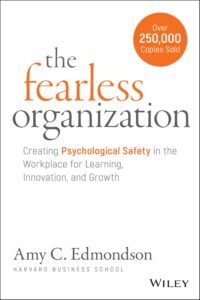
The Fearless Organization by Amy Edmondson is the primary researcher's own book-length treatment of the construct, its evidence base, and its application to building innovative organisations. Edmondson is careful about what the research shows and what it does not — she is the right person to present both the strength of the evidence and its limits. For any entrepreneur or team leader who has noticed that people hold back, that meetings are more polite than useful, or that the best ideas seem to arrive in informal conversations rather than structured sessions, this book identifies the mechanism with precision and gives the most evidence-grounded account of what leader behaviour actually produces the conditions that change it.
Why We Sleep
Article #178
The neuroscience of why early mornings and late evenings produce different types of creative business ideas
Why We Sleep by Matthew Walker synthesises the REM sleep and insight research alongside the hypnagogic creativity literature in a way that makes the neurological architecture of sleep feel urgent rather than academic. Walker's treatment of what REM sleep is actually doing — the loose associative consolidation that produces the morning insights entrepreneurs most value — is the most accessible version of the Wagner and Lacaux findings available. For any entrepreneur who has been treating sleep as a productivity tax rather than the cognitive infrastructure it actually is, this book is the most direct available case for reconsidering that position.
Stumbling on Happiness
Article #177
How mind-wandering serves a critical psychological function for strategic thinking
Stumbling on Happiness by Daniel Gilbert is the most accessible treatment of the human capacity for prospection — the mental time travel into personal futures that the DMN's self-referential processing produces. Gilbert's central argument is that the human ability to simulate future experience is both the most distinctive feature of the human mind and the source of the most systematic cognitive errors. For any entrepreneur trying to understand why they make the future choices they do — why long-term thinking feels so much harder than short-term thinking, and why the futures they plan for rarely feel the way they expected — this book provides the psychological framework with unusual clarity and wit.
Range
Article #176
How cognitive flexibility predicts entrepreneurial innovation better than intelligence
Range by David Epstein is the most accessible cultural synthesis of the cognitive flexibility argument. Epstein's central claim is that the ability to apply frameworks across domains — the cognitive signature of high flexibility — predicts innovative performance better than deep domain specialisation in complex, unpredictable environments. He documents this across elite sport, scientific discovery, artistic innovation, and business, and his central finding maps directly onto the neuroentrepreneurship evidence: the people who produce the most innovative outcomes are typically not the deepest experts in the specific domain of the innovation. They are the people with the broadest framework repertoire and the least attachment to any single one of them.
The Organised Mind
Article #175
The relationship between boredom and business innovation — and why being busy all the time kills creativity
The Organised Mind by Daniel Levitin is the most directly applicable treatment of the busyness-kills-creativity argument. Levitin synthesises the information overload and cognitive load research and applies it to professional decision-making, creative work, and the structural changes that constant connectivity has made to the cognitive environment. His estimate that Americans were processing approximately 100,000 words of information daily outside of work by 2011 — five times the load of 25 years prior — puts the cognitive cost of the modern information environment in terms that make the experimental findings immediately legible. For any entrepreneur trying to understand why their most intellectually demanding work keeps failing to produce the results they expect, this is the book that identifies the environmental culprit most precisely.
Incognito
Article #174
How the incubation effect means taking breaks from problems solves them faster
Incognito by David Eagleman provides the broader framework within which incubation operates — the argument that the vast majority of cognitive work, including problem-solving, happens below the level of conscious awareness. Eagleman writes with genuine clarity and wit, and his treatment of the unconscious cognitive processes that the incubation research documents makes the laboratory findings feel recognisable rather than academic. For any entrepreneur who has been puzzled by the pattern of their own best thinking — why solutions arrive when they stop trying, why rest produces breakthroughs that effort doesn't — this book provides the conceptual architecture that makes the pattern intelligible.
A Beautiful Constraint
Article #173
The psychology behind why constraints produce better creative output than unlimited freedom
A Beautiful Constraint by Adam Morgan and Mark Barden is the practitioner-facing synthesis of this research grounded in business case studies. Morgan and Barden document their propelling question methodology — how deliberately tight constraints reframe problems in ways that generate more innovative solutions than open-ended briefs — with examples drawn from entrepreneurial and corporate contexts that make the mechanism immediately applicable. For any entrepreneur who has ever had a breakthrough under pressure and wondered why their best ideas arrived when resources were tightest, this book provides both the explanation and the framework for designing those conditions deliberately rather than waiting for circumstance to impose them.
A Whole New Mind
Article #172
How psychological distance from a problem is the single best predictor of innovative solutions
A Whole New Mind by Daniel Pink makes the commercial case for exactly the kind of thinking that psychological distance enables — the big-picture, cross-domain, abstract pattern recognition that CLT identifies as the output of high-level construal. Pink argues that the economic conditions now reward this mode of thinking more than the analytical, detail-focused mode that formal education primarily trains. His argument and the CLT research reach the same conclusion from different directions: the ability to think at a distance from a problem is not a soft skill — it is the specific cognitive capability that generates the solutions analytical effort alone cannot.
The Eureka Factor
Article #171
The neuroscience of insight — what actually happens in your brain during a eureka moment
The Eureka Factor by John Kounios and Mark Beeman is the accessible synthesis of this research programme written by the two researchers who produced the foundational findings. Kounios and Beeman are scrupulous about distinguishing what the evidence shows from what it does not, and they connect the laboratory findings to real-world experience in a way that most neuroscience writing fails to achieve. For any entrepreneur who wants to understand the mechanics of their own best thinking — what conditions produced the insights that mattered, and how to create those conditions more reliably — this is the book that answers it from primary evidence rather than popular oversimplification.
Rest
Article #170
The psychology behind why your most creative business ideas come when you stop trying to be creative
Rest by Alex Soojung-Kim Pang is the most applicable synthesis of this research for entrepreneurs. Pang documents in detail how the world's most productive scientists, writers, artists, and business builders across history worked — and the consistent pattern is not the hustle-culture prescription of maximum hours. It is intensive morning work, protected recovery, regular walking, and the deliberate creation of conditions that allow incubation to occur. Darwin walked the same path every day. Dickens walked twenty miles. Poincaré described his mathematical breakthroughs arriving during unconscious processing with precision. Pang pulls the pattern together with the neuroscience and makes it directly applicable — not as a lifestyle philosophy but as a practical system for anyone who does work that requires genuine original thinking.
How Behavior Spreads
Article #169
How the social contagion theory explains why business trends thrive in some markets and fail in others
How Behavior Spreads by Damon Centola is the most directly relevant treatment of why the viral metaphor fails for business adoption and what the actual mechanics of behavioural spread look like. Centola synthesises a decade of complex contagion research and applies it to technology adoption, social movements, and organisational change — showing across each domain why the strategies that work for spreading information reliably fail for spreading behaviours, and what the alternative looks like in practice. For any entrepreneur trying to understand why their product is not spreading despite genuine early adoption, or why a competitor's model succeeded in one market and is stalling in another, this is the book that makes the mechanism legible rather than mysterious.
Exit, Voice, and Loyalty
Article #168
The cross-cultural psychology of customer complaints — why behaviour and opinions differ in different markets
Exit, Voice, and Loyalty by Albert Hirschman is the foundational text for the three-pathway framework that the entire cross-cultural complaint literature builds on. Published in 1970, Hirschman's analysis of when individuals choose exit, voice, or loyal waiting as responses to declining quality was originally a work of political economy — but its application to consumer behaviour and then to cross-cultural consumer behaviour has made it one of the most consequential frameworks in the field. The book is short, precise, and dense with insight. For any entrepreneur trying to understand why their customers in different markets behave differently when dissatisfied, and why the same measurement instrument produces opposite types of error in different cultural contexts, this is the framework that makes those differences intelligible.
The Spirit Level
Article #167
How the psychology of economic inequality shapes consumer behaviour and business opportunity simultaneously
The Spirit Level by Richard Wilkinson and Kate Pickett is the primary text — the most comprehensive empirical treatment of how inequality changes the psychological environment for everyone within a society, not just those at the bottom. Their cross-national comparison across 23 wealthy countries demonstrates that virtually every social outcome — mental health, physical health, trust, educational performance, social mobility — is worse in more unequal societies, at every income level. The book does not argue for a specific political programme. It argues from evidence that the psychological environment produced by inequality is measurably different from the one produced by equality, and that the difference shapes behaviour in ways that most economic analysis misses entirely. For any entrepreneur trying to understand the market they are operating in — what people actually want, why they want it, and what psychological needs their product genuinely serves — this is the book that provides the structural framework.
Bad Blood
Article #166
The psychology of business ethics across cultures — why 'right' and 'wrong' in business are psychologically constructed
Bad Blood by John Carreyrou is the most compelling recent case study of the moral judgment-action gap operating in a high-profile entrepreneurial context. The Theranos story is not primarily a story about a dishonest person — it is a story about the gradual normalisation of small ethical violations, each individually rationalised, accumulating into a catastrophic institutional failure. Carreyrou's reconstruction of how that process unfolded — who knew what, when, what they told themselves, and how the cultural environment of Silicon Valley's move-fast ethos made each incremental step feel acceptable — is the most accessible and most precise available documentation of the psychological mechanisms this article describes. For any entrepreneur building in an environment that rewards performance and punishes doubt, this is the book that most clearly illustrates what the normalisation of small ethical compromises actually looks like from the inside.
iGen
Article #165
How digital culture is creating a new generation of entrepreneurs with fundamentally different psychological profiles
iGen by Jean Twenge is the most comprehensive empirical treatment of how digital culture has altered the psychological profiles of the generation now entering entrepreneurship. Twenge's longitudinal data — drawn from surveys of millions of young people across decades — tracks the specific changes in attention, social connection, anxiety, independence, and risk orientation that digital nativity has produced. She is not alarmist and she is not dismissive: she is precise about what the evidence shows and honest about what it does not. For any entrepreneur trying to understand the generation they are hiring, the customers they are serving, or the psychological profile they themselves bring to building — this is the book that provides the empirical foundation rather than the generational stereotype.
Chavs: The Demonization of the Working Class
Article #164
The psychology behind why some business strategies work in London but fail in Manchester despite being in the same country
Chavs: The Demonization of the Working Class by Owen Jones is the most accessible and most honest treatment of the specific class psychology that shapes consumer and employee behaviour in northern English cities — and of how consistently that psychology is misread, dismissed, and commercially underserved by London-based businesses and media. Jones' central argument is that working-class identity in northern cities is not a deficit to be improved but a coherent cultural identity that is systematically devalued by institutions that mistake London's values for universal ones. For any entrepreneur building a business in Manchester or serving northern markets, this book provides the psychological framework for understanding why your audience responds the way it does — and why the London playbook will always underperform until it is replaced with something that genuinely respects the environment it is trying to serve.
The New Argonauts
Article #163
How migration psychology shapes entrepreneurial behaviour in immigrant-founded businesses
The New Argonauts by AnnaLee Saxenian is the most empirically rigorous treatment of how skilled immigrant engineers and entrepreneurs created the global technology ecosystem by moving between Silicon Valley and their countries of origin. Saxenian's research is the foundational evidence for bicultural competence as a competitive advantage — her account of how Taiwanese and Indian engineers in Silicon Valley leveraged their dual cultural positioning to build industrial networks that neither their American nor their origin-country counterparts could replicate is the clearest available demonstration of what the acculturation research documents at the level of individual psychology. It is also a genuinely compelling read about how global economic geography gets made, and why the human capital flows that produce it are more consequential than almost any other force in contemporary economic development.
Article #162
Why the 'hustle culture' narrative is a specifically American psychological construct that actually damages entrepreneurs globally
Rest by Alex Soojung-Kim Pang is the most research-grounded treatment of the empirical case against hustle culture's core claim that more hours produce more output. Pang synthesises the deliberate practice research, the creativity research, and the cognitive performance literature to show systematically that the world's most productive people — Darwin, Dickens, Poincaré, contemporary elite performers across every field — work fewer hours than hustle culture prescribes, and that the rest they protect is not recovery from their work but a constitutive part of what makes it good. The book does not argue for laziness. It argues, with substantial evidence, that the hustle culture prescription is not the path to the outcomes it promises — and that the alternative is both more sustainable and more effective.
Building Cross-Cultural Competence
Article #161
The psychology of status in business — why some cultures respect wealth and others respect expertise
Building Cross-Cultural Competence by Charles Hampden-Turner and Fons Trompenaars is the practical extension of Riding the Waves of Culture specifically applied to the business competence problem — how to navigate the achieved/ascribed dimension and others when the two parties' value systems are in direct conflict. Where Riding the Waves is the diagnosis, this book is the treatment. The section on achieved versus ascribed status and how to reconcile these values-in-conflict without either party losing face is the most practically grounded treatment of the dimension available. For any entrepreneur who has found themselves in the specific situation of needing to establish credibility with a counterpart whose status signals they cannot read or cannot produce, this is the book that provides the framework and the specific guidance for doing so without misrepresenting either culture's requirements.
World 3.0
Article #160
Why businesses that adapt to local psychology outperform businesses that export their home culture
World 3.0 by Pankaj Ghemawat is the most rigorous empirical treatment available of the distances — cultural, administrative, geographic, and economic — that determine when adaptation is necessary and when standardisation is viable. Ghemawat's CAGE framework gives entrepreneurs a practical analytical tool for making the standardisation-adaptation decision rather than defaulting to intuition or organisational inertia. He is also one of the most effective debunkers of the globalisation myth — the assumption that the world has become culturally homogeneous enough that local adaptation is no longer necessary. His data shows it has not, and his framework shows what to do about that. For any entrepreneur navigating international markets or building a product for multiple cultural contexts, this is the book that replaces instinct with a disciplined analytical approach.
Riding the Waves of Culture
Article #159
How the psychology of time orientation (past, present, future) varies by culture and affects strategic planning
Riding the Waves of Culture by Fons Trompenaars and Charles Hampden-Turner is the most practically grounded applied treatment of cultural time orientation and its business consequences. Trompenaars' seven-dimension framework — developed from over 60,000 questionnaires across 100 countries — includes the past, present, and future orientation model that extends meaningfully beyond Hofstede's binary. For any entrepreneur who has experienced the specific frustration of a cross-cultural strategic conversation that went nowhere despite both parties being genuinely engaged, this book provides the most useful diagnostic framework for understanding what was actually happening. It is not an academic text — it is built around real business situations and written to be immediately applied.
Startup Communities
Article #158
Why entrepreneurial ecosystems have distinct psychological profiles that shape every business within them
Startup Communities by Brad Feld is the most practically grounded treatment of how entrepreneurial ecosystem psychological profiles are built, and why most attempts to engineer them fail. Feld's central argument — that startup communities are built by entrepreneurs, not governments or institutions, and that the cultural conditions must lead rather than follow the structural ones — is the practitioner translation of the Stam and Isenberg academic frameworks. For any entrepreneur trying to understand why building in one city feels different from building in another, or anyone trying to actively contribute to building something in their own ecosystem, Feld is the clearest and most honest guide available. He is also unusually candid about what does not work, which makes the book more useful than most ecosystem literature that focuses on success stories alone.
The Presentation of Self in Everyday Life
Article #157
Why the concept of 'face' in East Asian business psychology applies universally but is named differently
The Presentation of Self in Everyday Life by Erving Goffman is the most comprehensive treatment of face-work as a universal feature of human social interaction. Goffman's dramaturgical framework — front stage, back stage, impression management — provides the theoretical infrastructure for understanding how face operates across all cultural contexts before culturally specific expressions are overlaid. It is not a business book, but it is the book that explains why every business interaction involves the management of something that Chinese culture calls mianzi and Western culture manages without naming. It is also unusually readable for a work of academic sociology — Goffman writes with genuine wit, and the observations about social behaviour feel recognisable rather than remote.
The Protestant Ethic and the Spirit of Capitalism
Article #156
Why the 'Protestant work ethic' is a psychological construct that affects business decisions even in secular entrepreneurs
The Protestant Ethic and the Spirit of Capitalism by Max Weber is more readable than its reputation suggests, particularly in the Penguin Classics translation. Weber is often cited and rarely read, which produces a significantly impoverished understanding of what the argument actually says — and what it does not say. The thesis is more careful, more hedged, and more psychologically precise than most summaries convey. For any entrepreneur who has noticed patterns in their own relationship to work, failure, external help, or leisure that feel out of proportion to their conscious beliefs, reading Weber directly is the most efficient way to understand where those patterns come from. It is not a long book, and it is considerably more interesting than its reputation as a sociology classic would suggest.
Article #155
How language shapes business thinking — why bilingual entrepreneurs make different strategic decisions in different languages
Through the Language Glass by Guy Deutscher is the most rigorously honest treatment available of what language actually does and does not do to thought. Deutscher is careful — more careful than most popular treatments of this topic — to distinguish between what the evidence genuinely supports about linguistic relativity and what is mythology. He takes seriously both the limits of the Sapir-Whorf hypothesis and the genuine findings about how the categories a language makes available shape what its speakers find easy to notice and easy to think. For any bilingual entrepreneur who has sensed that their thinking shifts between languages and wants to understand what is actually happening rather than what popular intuition suggests, this is the book that handles the question with the precision it deserves. It is also a genuinely enjoyable read — Deutscher writes about linguistics the way the best science writers handle physics, making technical questions feel urgent and accessible without simplifying them into falsehood.
The Hidden Injuries of Class
Article #154
How the psychology of social class affects entrepreneurial risk-taking and growth ambition
The Hidden Injuries of Class by Richard Sennett and Jonathan Cobb is the most psychologically rich account of what class origin actually costs at the level of identity, dignity, and self-concept. Published in 1972 and still unsurpassed in its depth, the book is built around extended interviews with working-class men navigating a society that simultaneously promises meritocracy and structures itself against them. What Sennett and Cobb document is not resentment or deficit — it is the specific emotional architecture that class installs: the relationship to ambition, to self-worth, to the experience of being judged, and to the effort required to maintain dignity across class lines. For any entrepreneur trying to understand why certain patterns in their risk behaviour or growth ambition feel hard to shift despite their current circumstances, this is the book that reaches furthest into the mechanism. It is qualitative counterpart to the Kraus research — not data, but experience made precise.
The Culture Map
Article #153
How cultural dimensions predict which business strategies will work in different countries
The Culture Map by Erin Meyer is the most practically useful contemporary tool for entrepreneurs navigating specific bilateral relationships. Meyer's eight cultural scales intersect with and extend Hofstede's dimensions, and her approach is built around real business interaction — meetings, negotiations, feedback conversations, decision-making processes — rather than abstract scores. Where Hofstede gives you the map, Meyer gives you what to do when you are actually in the room. Highly readable, immediately applicable, and particularly good for anyone who has experienced the confusion of a cross-cultural professional relationship that went wrong without knowing exactly why.
Start With Why
Article #152
The psychology of organisational identity — why 'who we are' matters more than 'what we do' for maximum productivity
Start With Why by Simon Sinek is the most accessible place to start if this article sparked something for you. Sinek's central argument — that people don't buy what you do, they buy why you do it — is essentially a practitioner translation of the Albert and Whetten framework, reaching the same conclusion through a different path. He builds it around real organisations, makes it immediately applicable, and writes in a way that doesn't require any academic background to follow. If you lead a team or run a business and you're trying to figure out why some organisations just seem to pull people in while others don't, this is the book that answers it in plain terms.
Speak Up: Say What Needs to Be Said and Hear What Needs to Be Heard
Article #151
The psychology of organisational silence — why employees stop sharing ideas long before they quit
Speak Up: Say What Needs to Be Said and Hear What Needs to Be Heard by Megan Reitz and John Higgins is the most practically grounded treatment of the silence-to-voice journey available. Reitz and Higgins's research on the specific conditions under which individuals feel safe to speak — and the specific leader behaviours that create or destroy those conditions — maps directly onto the Morrison and Milliken framework. For any entrepreneur who wants to understand not just why silence develops but what leaders actually do differently in organisations where people speak up, this is the most direct available account of the behavioural specifics.
Stolen Focus
Article #150
How the mere presence of a phone on a desk reduces cognitive capacity — even when turned off
Stolen Focus by Johann Hari is the most accessible and research-grounded treatment of the full ecosystem of attention disruption — including smartphone design, notification architecture, and the social conditions that make phone separation feel costly. Hari's account of the attention economy and how it is structured to maximise the habitual approach impulses that the suppression load mechanism requires maps directly onto the Ward et al. finding. For any entrepreneur who wants to understand not just what the phone is doing to their cognitive capacity in the moment but how the design choices that produced that dependency were made, this is the most readable and most practically useful starting point.
Crucial Conversations
Article #149
Why the most psychologically healthy organisations tolerate productive conflict
Crucial Conversations by Kerry Patterson, Joseph Grenny, Ron McMillan and Al Switzler is the most practically grounded treatment of how to conduct task-level disagreement without triggering the relationship conflict escalation that destroys its value. Their framework maps directly onto the interaction norm variable that Jehn and Mannix identify as the primary moderator of whether conflict stays productive. For any entrepreneur who understands the research and wants a practical skill framework for what to actually say and do when a high-stakes disagreement is beginning to tip from productive to personal, this is the most directly applicable available starting point.
The Fifth Discipline
Article #148
The psychology of organisational memory — why companies keep making the same mistakes
The Fifth Discipline by Peter Senge is the most widely read applied treatment of how organisations can build the learning infrastructure needed to avoid the repeated mistake problem. Senge's five disciplines — systems thinking, personal mastery, mental models, shared vision, and team learning — are the practitioner answer to the Levitt and March diagnosis. His argument that organisations systematically fail to learn because their members cannot see the systemic structures producing the patterns they experience is the most accessible available account of why individual intelligence and organisational intelligence are not the same thing, and what the gap between them costs.
Group Genius: The Creative Power of Collaboration
Article #147
Why brainstorming sessions produce worse ideas than individuals working alone
Group Genius: The Creative Power of Collaboration by Keith Sawyer is the most practically grounded treatment of what actually makes group creative processes work — and what does not. Sawyer synthesises the brainstorming research literature and identifies the specific conditions under which group interaction adds genuine value to individual creativity as opposed to subtracting from it. His argument is not that groups are always worse than individuals but that the specific format of Osborn's face-to-face brainstorming is systematically designed to activate the mechanisms that produce the deficit, and that redesigning the process architecture along the lines the research prescribes recovers most of the lost value. For any entrepreneur who runs team ideation sessions and wants to understand both why the current format is underperforming and what specifically to replace it with, this is the most direct available starting point.
Grooming, Gossip, and the Evolution of Language
Article #146
The psychology of workplace gossip — why it serves a genuine psychological function
Grooming, Gossip, and the Evolution of Language by Robin Dunbar is the foundational text for the evolutionary account of gossip as social maintenance and the most rigorous available argument for why the two-thirds conversation statistic should reframe rather than alarm anyone thinking about workplace communication. Dunbar's central thesis — that language evolved primarily to service social networks, and that gossip is the primary vehicle through which it does so — makes the case that suppressing gossip is not a management strategy but a misunderstanding of what human social communication is fundamentally for. For any entrepreneur who wants to understand why their team gossips and what it would actually cost to prevent them, this is the most direct and most intellectually substantial starting point available.
The Status Game
Article #145
How social comparison in the workplace drives both motivation and toxicity simultaneously
The Status Game by Will Storr is the most accessible contemporary treatment of how status competition — the applied form of social comparison — drives both the highest-quality human achievement and the most destructive interpersonal behaviour, and why the same mechanism produces both simultaneously. Storr draws on evolutionary psychology, neuroscience, and historical case studies to argue that the pursuit of relative status is one of the most powerful forces in human motivation — and that the environments humans create to channel it determine whether it produces the cooperation and striving that build organisations or the sabotage and malicious envy that destroy them. For any entrepreneur who wants to understand the deeper logic of why their team dynamics look the way they do, it is the most readable and most practically illuminating available account of the mechanism at work.
Make It Stick: The Science of Successful Learning
Article #144
Peter Brown, Henry Roediger and Mark McDaniel
Make It Stick: The Science of Successful Learning by Peter Brown, Henry Roediger and Mark McDaniel is the most accessible synthesis of CLT, the spacing effect, the testing effect, and interleaving available to a non-specialist reader. The book translates decades of learning science research into specific, counter-intuitive design principles — the most important being that the training methods that feel most productive to learners and trainers are often the least effective, while the methods that feel most difficult and uncomfortable tend to produce the most durable learning. For any entrepreneur making decisions about how to train their team, it provides the most direct available evidence that the training investment they are currently making is probably designed in exactly the way that minimises its return.
The Lucifer Effect
Article #143
The bystander effect in organisations — why nobody reports problems they all see
The Lucifer Effect by Philip Zimbardo is the most comprehensive treatment of how situational factors — including diffusion of responsibility, authority hierarchies, and the gradual normalisation of inaction — produce the bystander dynamics that allow organisational problems to persist without intervention. Zimbardo's analysis extends well beyond the Stanford prison experiment to the specific institutional structures that make good people silent in organisations where bad things are happening. For any entrepreneur who wants to understand not just the mechanisms but the systemic conditions that sustain them, and what dismantling those conditions actually requires, this book provides the most rigorous and most honest available starting point.
The Advantage
Article #142
Why reward systems based on individual performance destroy team collaboration
The Advantage by Patrick Lencioni is the most practically grounded treatment of how reward and accountability structures must be aligned with collaborative cultural values to produce genuine organisational health. Lencioni's argument — that misaligned incentives are one of the most common causes of dysfunctional team behaviour, and that cultural interventions cannot substitute for structural alignment — maps directly onto the Deutsch cooperation-competition framework. For any entrepreneur who has tried to address team collaboration problems through values and culture while leaving the reward structure unchanged, this book provides both the diagnosis of why that approach is insufficient and the most accessible available account of what structural alignment actually requires.
The Extended Mind: The Power of Thinking Outside the Brain
Article #141
How the physical environment of your office shapes the quality of decision-making
The Extended Mind: The Power of Thinking Outside the Brain by Annie Murphy Paul is the most directly relevant treatment of how the physical environment functions as a cognitive resource rather than a mere container for cognition. Paul's argument — that thinking happens not just inside the brain but through the body, through gesture, and through the physical environment — provides the theoretical foundation for the entire office environment and decision-quality research programme. For any entrepreneur who wants to understand not just the specific research findings but the deeper case for why environmental design is a cognitive intervention, this book is the most intellectually satisfying and most practically motivating starting point available.
Together: The Healing Power of Human Connection in a Sometimes Lonely World
Article #140
Why remote workers experience loneliness differently from in-office isolation
Together: The Healing Power of Human Connection in a Sometimes Lonely World by Vivek Murthy is the most rigorous and most compassionate treatment of loneliness as a public health crisis available. Murthy's framework of three dimensions of loneliness — intimate, relational, and collective — provides the conceptual structure for understanding why remote work produces a specific loneliness profile rather than a simple reduction in contact, and why different dimensions require different responses. For any entrepreneur managing a remote team or navigating remote work personally, it is the most humane and most practically grounded starting point available.
The Power of Ritual
Article #139
The psychology of workplace rituals — why random tasks and games work even when they feel pointless
The Power of Ritual by Casper ter Kuile is the most practically grounded contemporary treatment of how to design meaningful rituals in secular and workplace contexts. Ter Kuile's framework for identifying what makes any repeated practice become a genuine ritual rather than mere routine — and what distinguishes rituals that develop meaning over time from activities that remain empty habits — is directly applicable to the workplace context the article describes. For any entrepreneur who wants to understand not just what the psychology predicts about rituals but what specifically to do to build them authentically in a team environment, this is the most accessible and most practically direct available starting point.
Deep Work
Article #138
Why open-plan offices reduce productivity — the psychology of environmental distraction
Deep Work by Cal Newport is the most practically grounded treatment of why cognitively demanding knowledge work requires extended periods of uninterrupted focus — and why the open-plan office is structurally incompatible with the environmental conditions that serious thinking requires. Newport's framework draws directly on the irrelevant speech effect and interruption cost research documented in this article, and his prescriptions — time-blocking, deliberate isolation, communication discipline — are the behavioural antidotes to the cognitive costs the architecture imposes. For any entrepreneur designing their own working environment or managing a team, this book provides the most direct available account of what the research demands in practice, and why protecting focused time is not a personal preference but a prerequisite for the quality of output that knowledge work requires.
Don’t Make Me Think
Article #137
Why your pricing page layout influences decisions more than the actual prices on it
Don't Make Me Think by Steve Krug is the most practically grounded available treatment of how users actually experience web interfaces — and the applied foundation for every claim in this article about how scan paths and visual hierarchy determine decisions. Krug's central insight is that users scan rather than read, and that they satisfice rather than optimise — they take the first reasonable option they encounter rather than evaluating all options to find the best one. His documentation of how this actually plays out across real interface decisions is the most direct available translation of the eye-tracking and pre-attentive processing research into actionable guidance for anyone designing a pricing page. For any entrepreneur who wants to understand not just why layout matters but specifically what to do about it, this book is the most readable and most immediately useful starting point available.
The Art of Pricing
Article #136
The psychology behind why 'most popular' plan labels increase selection by 30-40%
The Art of Pricing by Rafi Mohammed is the most practically grounded available treatment of how pricing architecture — including tier structure, anchoring, and the psychology of choice — can be deliberately designed to guide customers toward the options that serve both their needs and the seller's revenue goals. Mohammed's framework for thinking about willingness to pay across different customer segments maps directly onto the mechanisms this article describes: the "most popular" label works because it resolves genuine uncertainty about which tier fits the buyer's situation, and Mohammed's approach to segmented pricing architecture provides the strategic context for understanding where that uncertainty comes from and how to design around it. For any entrepreneur building a multi-tier pricing page from scratch, or restructuring an existing one that isn't converting, this book provides the most direct available bridge between pricing psychology and the specific decisions that determine how a pricing page actually performs.
The Culture Map
Article #135
Why odd/even pricing psychology differs across cultures — and what this means for international businesses
The Culture Map by Erin Meyer is the most practically grounded modern treatment of how cultural dimensions affect business communication and decision-making. Meyer's eight scales of cultural difference — including the communication scale that maps directly onto Hall's high/low context distinction — give the abstract pricing research concrete operational form. For any entrepreneur navigating international market entry decisions, her framework translates cultural theory into specific, actionable guidance for how to adapt not just pricing but every dimension of commercial communication to the cultural context in which it lands.
Dollars and Sense
Article #134
The psychological impact of currency symbols — why removing the currency ($) sign from menus increases spending
Dollars and Sense by Dan Ariely and Jeff Kreisler is the most accessible available treatment of why currency representations are never neutral — why the pain of paying varies with how visible the transaction is made, and how different pricing presentations modulate the intensity of that pain. Ariely's treatment of the mechanisms by which restaurants, subscription services, and luxury retailers systematically reduce the visibility of the payment act — and why this works despite consumers being intellectually aware of it — is the most readable available account of the mechanisms this article documents. For any entrepreneur making decisions about how to present prices across any medium, it is the most directly relevant starting point available.
Deluxe: How Luxury Lost Its Luster
Article #133
The prestige pricing effect — why luxury products sell more at higher prices
Deluxe: How Luxury Lost Its Luster by Dana Thomas is the most practically grounded journalistic account of how luxury brands manage — and sometimes destroy — the Veblen effect through production, distribution, and licensing decisions. Thomas's reporting on LVMH, Burberry, Gucci, and the broader luxury industry over the period when mass-market expansion strategies collided with Veblen economics provides the commercial case study material that makes the abstract mechanism concrete. For any entrepreneur thinking about premium positioning and the conditions under which it holds or collapses, this is the most direct available account of what the Veblen architecture looks like from the inside of the brands that built and then damaged it.
Pricing: Making Profitable Decisions
Article #132
How the Weber-Fechner law explains why a £10 increase on a £50 product feels massive but on a £500 product feels invisible
Pricing: Making Profitable Decisions by Kent Monroe is the most rigorous applied treatment of the Weber-Fechner framework in pricing available. Monroe's synthesis of the psychophysics literature and its pricing applications — including his foundational 1971 work on logarithmic price scales and acceptable price ranges — is the academic text that translated the 19th-century sensory research into something directly applicable to how entrepreneurs should think about price sensitivity, change thresholds, and the relative perception of discounts and increases. For any entrepreneur who wants to understand the perceptual mechanics of pricing rather than just its economics, it is the most direct available starting point.
Pricing with Confidence
Article #131
Why raising your prices psychologically attracts better customers — not fewer customers
Pricing with Confidence by Reed Holden and Mark Burton is the most rigorous applied treatment available of how to raise prices without losing customers. Holden and Burton's research on customer price sensitivity segmentation — identifying which customers are genuinely price-sensitive and which are using price as a proxy for quality — is the applied operationalisation of the Rao and Monroe research that makes the article's central argument actionable. For any entrepreneur who understands intellectually that higher prices attract better customers but needs the practical framework for how to implement that insight without losing existing relationships, this book provides the most direct available starting point.
The Psychology of Price
Article #130
How context-dependent pricing means the same product can be worth £10 or £100 depending on framing
The Psychology of Price by Leigh Caldwell is the most practically grounded treatment of context-dependent pricing available. Caldwell's framework for understanding how buyers construct value — and specifically how sellers can shape that construction through context, framing, and positioning — is the applied operationalisation of Thaler's theoretical framework. Where Thaler establishes the mechanism through elegant laboratory experiments, Caldwell translates it into the specific decisions an entrepreneur makes when designing a pricing architecture: how to present, what to signal, how to frame the transaction, and which mental account to activate. For any entrepreneur who wants to understand not just that context determines value but what to actually do about it, this book is the most direct available starting point.
Brainfluence
Article #129
The neuroscience behind why £97 feels dramatically cheaper than £100 (charm pricing)
Brainfluence by Roger Dooley is the most practically grounded compendium of neuromarketing research applied directly to business decisions. Dooley's treatment of pricing psychology — including the left-digit effect, charm pricing, and prestige pricing — is written with the specific goal of translating laboratory findings into decisions an entrepreneur can make on Monday morning. His guidance on which pricing format works for which consumer psychology and which product category is the most directly actionable available treatment of the mechanisms this article describes, and it sits alongside the Poundstone and Ariely books as the third essential text for any entrepreneur who wants to understand what price actually communicates to the brain of the person reading it.
A Complaint is a Gift
Article #128
The psychology behind why customers who complain are your most valuable asset
A Complaint is a Gift by Janelle Barlow and Claus Møller is the foundational practitioner text on the complaint-as-asset philosophy, and its title is the most concise available statement of the article's central argument. Barlow and Møller operationalise the TARP research and the service recovery paradox into a practical complaint-handling methodology that addresses every dimension of the justice framework the research identifies — distributive, procedural, and interactional. Their treatment of why the customer who complains is giving the brand a gift that the silently departing customer withholds is both the most readable available account of the mechanism and the most directly applicable to any entrepreneur building a customer service system from scratch. For any entrepreneur who has been treating complaints as problems to be closed rather than intelligence to be learned from, this book is where to start.
The Future of Nostalgia
Article #127
How the nostalgia effect in marketing creates emotional connections that bypass rational evaluation
The Future of Nostalgia by Svetlana Boym is the most theoretically rigorous treatment of nostalgia as a cultural phenomenon available. Boym's distinction between restorative nostalgia — which seeks to recover the past as it was — and reflective nostalgia — which dwells on longing without expecting recovery — maps directly onto the two types of nostalgic marketing that produce different consumer responses. Restorative nostalgia produces the urgency of the limited edition and the retro console; reflective nostalgia produces the slower, richer emotional engagement of brands like Coca-Cola and Levi's. Understanding which type a brand is activating is the first design decision in any nostalgia-based marketing strategy, and Boym's framework is the most rigorous available starting point for making that distinction clearly.
Product-Led Growth
Article #126
The endowment effect in free trials — why customers value something more after they've used it for 7 days
Product-Led Growth by Wes Bush is the most practically grounded treatment of how to design free trial and freemium experiences that deliberately engineer ownership psychology. Bush's activation and engagement frameworks are operationalisations of Pierce et al.'s psychological ownership routes into product design decisions — turning the academic mechanisms of control, intimacy, and self-investment into specific product features and onboarding sequences. For any entrepreneur building a product with a free tier or trial period, it provides the most direct available translation of the endowment effect research into the actual decisions that determine whether a trial converts.
Ogilvy on Advertising
Article #125
The bizarreness effect — why unusual marketing is remembered better than conventional marketing
Ogilvy on Advertising by David Ogilvy is the foundational practitioner text on advertising memorability, written by someone who spent decades studying what actually makes advertisements remembered and acted upon. Ogilvy's research predates the formal bizarreness effect literature by years but independently documents many of the same principles — the memory advantage of unexpected creative approaches, the retrieval advantage of distinctive brand imagery, and the commercial cost of advertising that blends into its environment rather than standing out from it. His account of why the most creative advertisements are rarely the safest ones, and why the safest advertisements are rarely the most effective ones, provides both the practitioner evidence and the creative philosophy for applying the distinctiveness principle in practice. For any entrepreneur making decisions about creative strategy, it is the most practically grounded available account of what the psychology of memory means for the work of advertising.
Influence Is Your Superpower
Article #124
Why limited-time offers work psychologically even when customers know they're marketing tactics
Influence Is Your Superpower by Zoe Chance is the most recent applied treatment of how influence mechanisms operate even when targets are fully aware of them. Chance's research at Yale on why knowing about a persuasion tactic rarely provides immunity from it is the most direct academic treatment of this article's central question — and her account of the mechanisms through which emotional responses outpace and override rational awareness provides both the theoretical framework and the practical self-defence tools for anyone who wants to understand why they keep buying things they did not plan to buy. For any entrepreneur using urgency tactics in their own marketing, the book provides equal insight into why those tactics work and what distinguishes their ethical from their manipulative application.
Persuasive Technology: Using Computers to Change What We Think and Do
Article #123
The psychology of trust in digital environments — what makes strangers give you their credit card details
Persuasive Technology: Using Computers to Change What We Think and Do by BJ Fogg is the primary source for the Prominence-Interpretation Theory, the web credibility research, and the foundational framework for understanding how digital environments produce trust and persuasion. Fogg spent years at Stanford's Persuasive Technology Lab studying the specific mechanisms through which computers and websites change what people believe and what they do — and the research documented in this book is the most rigorous available account of why design is not an aesthetic preference but a trust mechanism, why the manipulation-detection heuristic fires when it does, and how digital environments can be structured to produce the credibility signals that strangers need before they will commit to a transaction. For any entrepreneur building a digital product or online sales environment, this is the most directly applicable available treatment of the psychological architecture that determines whether strangers will trust them with their money.
Made to Stick
Article #122
The psychology behind why longer landing pages convert better for high-consideration purchases
Made to Stick by Chip and Dan Heath is the most applicable treatment of why specific, concrete, story-based information structures are more persuasive than abstract claims — and the most direct guide to how to build the argument architecture that makes a long landing page convert. Their SUCCESs framework — Simple, Unexpected, Concrete, Credible, Emotional, Stories — maps directly onto the information architecture of high-converting long-form pages, providing a practical template for turning the ELM's central route insight into actual page structure. For any entrepreneur writing copy for a high-consideration product, it is the most useful bridge between the psychology of persuasion and the craft of building a page that answers every question before the buyer has to ask it.
Never Split the Difference
Article #121
Why customers anchor to the first price they see and all subsequent prices are judged relative to it
Never Split the Difference by Chris Voss is the most practically grounded negotiation treatment of the anchoring mechanism available. Voss, a former FBI hostage negotiator, develops the "extreme anchor" technique — setting a first offer that is deliberately high to establish a reference point well above the seller's actual target, giving room for the buyer to feel they have achieved a concession while still landing at a favourable outcome. His treatment of how to set anchors, how to respond to incoming anchors from buyers, and the psychological dynamics of adjustment from a reference point provides the most immediately applicable account of the pricing anchoring research for anyone conducting sales conversations. For any entrepreneur who negotiates pricing, partnerships, or contracts, it is the most direct available translation of the anchoring research into practical technique.
Alchemy
Article #120
How the scarcity principle drives urgency without feeling manipulative when done ethically
Alchemy by Rory Sutherland is the most practically irreverent treatment available of why psychological value — including the value generated by genuine scarcity — consistently outweighs rational utility value in determining what people want and what they pay for it. Sutherland's argument, drawn from his decades at Ogilvy and his engagement with behavioural economics research, is that entrepreneurs who understand the psychological mechanisms of value creation can generate genuine desirability without competing purely on functional attributes or price. His treatment of why illogical pricing and genuine exclusivity create value that rational product improvements cannot replicate provides the philosophical framework for understanding scarcity as a legitimate value-creation tool rather than merely a manipulation tactic. For any entrepreneur who wants to understand why perceived scarcity generates desire that abundant availability cannot match — and how to use that understanding ethically — this is the most readable and most thought-provoking starting point available.
Contagious
Article #119
Why social proof works better when it comes from people similar to the buyer (not celebrities or influencers)
Contagious by Jonah Berger is the most practically grounded available treatment of the social transmission mechanisms that make peer influence so powerful relative to celebrity or top-down endorsement. Berger's research on why products and ideas spread through peer networks — documenting that word-of-mouth conversations drive approximately 20 to 50 percent of purchasing decisions across categories — provides both the mechanism and the commercial scale of peer social proof. His framework for understanding what makes peer-shared social proof credible and memorable is the most directly applicable account of similarity-based influence for an entrepreneur building a customer acquisition strategy.
Priceless
Article #118
Why customers who pay more report higher satisfaction (the price-quality heuristic)
Priceless by William Poundstone is the most accessible and comprehensive treatment of the psychology of pricing available. Poundstone synthesises the price-quality heuristic research, the anchoring effects that govern price perception, and the neurological evidence including the Plassmann wine study into a coherent framework for understanding why prices are never just numbers — they are psychological signals that alter what people expect, what they experience, and how much they enjoy it. For any entrepreneur making pricing decisions, this book provides the most readable available account of the psychological forces governing how price is perceived and what it does to the people who pay it.
Decoded
Article #117
The psychology of why customers say they want X but buy Y (stated vs revealed preferences)
Decoded by Phil Barden is the most practically applicable treatment of the gap between what consumers say and what actually drives their purchase decisions. Barden spent over 25 years as a senior marketer at Unilever, Diageo, and T-Mobile before immersing himself in decision science, and the book combines that practitioner experience with a rigorous treatment of the neuroscience and behavioural economics research. His reward-minus-pain framework for understanding purchase decisions is the most directly usable available model for translating the stated-revealed preference gap into product and pricing decisions. For any entrepreneur who has discovered that what customers said they wanted in research and what they actually bought were different things, this book provides the most direct and most practically grounded explanation of why — and what to design for instead.
The Challenger Launch Decision
Article #116
Why diverse leadership teams make slower decisions but fewer catastrophic mistakes
The Challenger Launch Decision by Diane Vaughan is the most forensically detailed available account of how a homogeneous organisational culture produces catastrophic decision failures. Vaughan spent years analysing every meeting, memo, and decision in the lead-up to the Challenger disaster, and her central finding — that the engineers and managers involved were not negligent or irrational but were following the shared cognitive framework of a deeply homogeneous culture that had normalised risk through repeated exposure — is the most precise available documentation of what the absence of genuine dissent costs. For any entrepreneur building a leadership culture, this book provides the clearest real-world account of how the mechanisms described in this article play out at their most consequential extreme.
Getting to Yes
Article #115
The psychology of trust repair after broken promises
Getting to Yes by Roger Fisher and William Ury is the most widely used applied treatment of how to structure explicit commitments in negotiation and professional contexts in ways that reduce the vulnerability that promise-making creates. The Schweitzer research established that making an explicit promise amplifies both the initial trust gain and the damage when the promise is broken — and Fisher and Ury's principled negotiation framework provides the practical alternative: structuring agreements around interests, criteria, and options rather than explicit personal commitments, which achieves the same alignment without creating the amplified downside that a broken promise carries. For any entrepreneur who finds themselves regularly making commitments they cannot consistently keep, this book offers the most directly useful framework for how to build reliable agreements that do not require the kind of explicit promise-making that turns every delivery failure into a trust violation.
What Got You Here Won’t Get You There
Article #114
How your management style was unconsciously modelled on whoever managed you first
What Got You Here Won't Get You There by Marshall Goldsmith is the most practically grounded treatment of how successful people are held back by behavioural habits that served them in earlier contexts and have become liabilities in their current role. Goldsmith's twenty habits — which include telling the world how smart you are, adding too much value to every discussion, passing judgement rather than allowing others to develop, and failing to give adequate recognition — are, in the framework this article establishes, the behavioural expressions of management templates that were adaptive at one stage and counterproductive at another. His approach is behavioural rather than psychological, which makes it immediately actionable for entrepreneurs who want to change specific management patterns without necessarily working through the developmental history that installed them. For any founder who wants to understand not just why their management style looks the way it does but specifically what to do about it, this is the most direct available starting point.
Lost and Founder
Article #113
The empathy gap between founders and employees — why they cannot understand each other
Lost and Founder by Rand Fishkin is the most honest first-person account of the empathy gap in practice available. Fishkin documents his own failures to understand what his employees were experiencing while they simultaneously failed to understand what he was experiencing — and he does so without the self-exoneration that characterises most founder memoirs. His account of building Moz from the inside is the most directly applicable real-world narrative for the mechanisms this article establishes: the founder who cared more than anyone around them and could not understand why that care was not reciprocated, and the employees who could not understand why their founder found ordinary setbacks catastrophic. For any entrepreneur who recognises the dynamic described here and wants to understand it from the inside, this is the most direct available starting point.
The Wisdom of Teams
Article #112
The psychology of social loafing — why people work harder alone than in groups
The Wisdom of Teams by Jon Katzenbach and Douglas Smith is the most practically grounded available treatment of what separates genuine high-performing teams from groups that look like teams but function like collections of individuals managing their own effort. Their distinction between working groups and real teams — and their account of what the commitment and accountability structures of a real team actually look like in practice — addresses the social loafing problem at its structural source. For any entrepreneur who wants to understand not just why teams underperform but what specifically to build to prevent it, this is the most directly actionable starting point.
Burnout: The Secret to Unlocking the Stress Cycle
Article #111
The psychology of burnout contagion — how one exhausted leader infects an entire organisation
Burnout: The Secret to Unlocking the Stress Cycle by Emily and Amelia Nagoski is the most research-grounded and practically useful treatment of burnout available. Their central insight — that burnout is a failure to complete the physiological stress response cycle, not a personal failing or a scheduling problem — reframes the entire recovery question. For any entrepreneur who has tried to think or plan their way out of exhaustion without success, this book explains precisely why that approach fails and what the body actually needs instead.
Grit
Article #110
Why praising effort rather than talent produces measurably better team performance
Grit by Angela Duckworth is the most compelling adult-performance counterpart to Dweck's childhood praise research. Where Dweck's work shows that praise type determines how children respond to challenge, Duckworth's longitudinal research with West Point cadets, National Spelling Bee competitors, and sales teams shows that effort and persistence explain achievement variance in adults that talent measures consistently fail to predict. Her argument — that the combination of passion and perseverance outperforms raw ability across every high-achievement domain studied — is both the empirical case for effort-based culture and the most persuasive available reframe of what it means to build a high-performing team. For any entrepreneur who wants to understand what they are actually selecting for when they hire, and what they are actually building when they give feedback, this book provides the most direct available answer.
The Emotionally Intelligent Manager
Article #109
Why emotional intelligence predicts leadership success twice as accurately as IQ
The Emotionally Intelligent Manager by David Caruso and Peter Salovey is the most scientifically grounded applied treatment of emotional intelligence available and the most directly useful for anyone who wants to work with the construct seriously rather than through the popular framing. Salovey is one of the original scientific discoverers of EI, and this book applies the four-branch MSCEIT model to managerial practice with the rigour that Goleman's popular writing trades away for accessibility. Caruso and Salovey's treatment of how to use emotional information strategically — not just manage emotions, but actively use what emotions are communicating as data for better decisions — is the most practically sophisticated account of what high EI leadership actually looks like from the inside. For any entrepreneur who has read Goleman and wants to understand what the construct actually means beyond the popular framing, this is the most direct available upgrade.
The Art of Possibility
Article #108
How the Pygmalion effect means your expectations of employees shape their capabilities
The Art of Possibility by Rosamund Stone Zander and Benjamin Zander is one of the most directly applicable treatments of the Pygmalion mechanism available outside academic literature. Benjamin Zander, conductor of the Boston Philharmonic, documents his practice of giving every student in his master class an A at the start of the year — not as a grade to be earned but as an expectation to be inhabited. His account of what happened to students' performance, confidence, and creative risk-taking when the expectation of excellence was established rather than withheld maps precisely onto the four-factor transmission mechanism the article describes. Zander's framing — that the conductor's job is to make other people powerful — is the practitioner version of the Pygmalion insight: the leader's belief in the team is not a private feeling but a force that shapes what the team becomes. For any entrepreneur who wants to understand what deliberately high-expectancy leadership looks and feels like from the inside, this is the most readable and most practically vivid account available.
The Culture Code
Article #107
Why leaders who show vulnerability build stronger teams than leaders who project invincibility
The Culture Code by Daniel Coyle is the most compelling case study-driven treatment of how vulnerability loops — cycles of genuine admission met with genuine response — build the safety and cohesion that produce high-performing teams. Coyle's documentation of how the Navy SEALs, Pixar, and championship sports teams create belonging and performance through deliberate vulnerability practices is the applied evidence base for the mechanisms this article describes. His concept of the vulnerability loop — where one person's genuine admission of uncertainty or mistake creates the condition for another's, building a cumulative culture of safety — gives the research a concrete operational form. For any entrepreneur who understands the mechanisms intellectually and wants to know specifically what to do in a team meeting, a one-to-one conversation, or a difficult decision moment, this book provides the most directly actionable available account of what building a high-trust team actually looks and feels like from the inside.
Thanks for the Feedback
Article #106
The psychology of feedback — why most performance reviews actually decrease performance
Thanks for the Feedback by Douglas Stone and Sheila Heen is the most practically grounded available treatment of why feedback fails and what can be done about it. Stone and Heen's three-trigger framework — truth triggers, which fire when the feedback feels factually wrong; relationship triggers, which fire when the relationship with the person giving feedback contaminates the reception of it; and identity triggers, which fire when the feedback threatens the recipient's sense of who they are — maps directly onto the FIT self-level attention mechanism and the ego threat research this article draws on. Their research on how different people's identity stability determines their vulnerability to the identity trigger is particularly useful for any entrepreneur managing a team with varying levels of psychological resilience. The book is rigorous without being inaccessible, and it provides the most direct available translation of the Kluger and DeNisi framework into management behaviour that can be changed on Monday morning.
The No Asshole Rule
Article #105
Why one toxic team member reduces collective performance by up to 40% (The bad apple effect)
The No Asshole Rule by Robert Sutton is the most widely read applied treatment of the bad apple phenomenon and the most honest available reckoning with its commercial costs. Sutton's total cost of assholes framework — which attempts to quantify the full financial impact of one persistently hostile team member across turnover, reduced productivity, management time, and psychological damage — extends the Felps et al. research into a practical business case that is difficult to dismiss. His documentation of why bad apples survive in organisations despite their obvious costs — seniority, specialist knowledge, fear of conflict, ambiguity about what constitutes toxic behaviour — is the most useful available treatment of the gap between what organisations know and what they do. For any entrepreneur who has been aware of a team toxicity problem and delayed addressing it, this book provides both the evidence for why delay is costly and the framework for acting on it.
Rebel Ideas
Article #104
How cognitive diversity in teams produces better results but more conflict
Rebel Ideas by Matthew Syed is the most accessible applied synthesis of the cognitive diversity research programme available. Syed draws on the same BCG data, the same elaboration model, and the same task-versus-relationship conflict distinction to build a practical case for why organisations that select for agreement — that surround their leaders with people who think similarly — are making one of the most expensive strategic errors available. His treatment of echo chambers, marginal revolutionaries, and the specific failure modes of cognitively homogeneous teams is both rigorously grounded and immediately recognisable to anyone who has watched a founding team converge too quickly on a bad idea. For any entrepreneur building their first leadership team, it is the most directly actionable starting point available on this specific question.
The Human Side of Enterprise
Article #103
Why micromanagers create the exact outcomes they're trying to prevent
The Human Side of Enterprise by Douglas McGregor is the foundational text for the central argument of this article, and one of the most important management books ever written. McGregor's original case in 1960 — that management style does not respond to employees, it creates them — remains the clearest and most rigorous available account of why the assumptions a leader holds about human motivation become self-fulfilling through the management behaviour those assumptions generate. His Theory X and Theory Y distinction is not a typology of employees. It is a typology of what different management approaches produce in the same employees. For any entrepreneur who has found themselves tightening oversight in response to declining quality and wondering why the quality keeps declining, this book provides the most direct and most honest explanation of what is actually happening. It was written sixty-five years ago and describes most modern organisations with uncomfortable precision.
The Power Paradox
Article #102
How power changes your brain chemistry and makes you worse at empathy
The Power Paradox by Dacher Keltner is the primary source for the twenty-year research programme this article draws on, and the most directly relevant single text available on this subject. Keltner writes with unusual honesty about what his own decades of research revealed — that the people most likely to acquire power are those with the greatest social and empathic capacity, and that those same people are then systematically pushed away from those capacities by the very power they earned. The book covers the neurological findings, the mirroring suppression research, the empathy deficit studies, and the accountability antidote in a way that is both rigorously grounded and genuinely readable. For any entrepreneur who has noticed themselves becoming less curious about others, less willing to update on feedback, or less attuned to the emotional states of the people around them — and who wants to understand why that might be happening and what can actually be done about it — this is the most direct and most honest starting point available.
The Positive Power of Negative Thinking
Article #101
Why the best leaders allow themselves to be anxious — the paradox of productive worry
The Positive Power of Negative Thinking by Julie Norem is the book-length treatment of defensive pessimism by its originator — the most comprehensive and accessible account of when and why allowing negative thinking and anxiety produces better outcomes than positive reframing. Norem draws on her decades of research to demonstrate that the cognitive strategy most of us are told to abandon — imagining what could go wrong, sitting with worry, refusing to force optimism — is for a significant subset of people the strategy most closely associated with high performance, good preparation, and psychological wellbeing. For any entrepreneur who has always found positive visualisation hollow or counterproductive, this book offers both the research explaining why that might be rational and the most honest available treatment of the conditions under which worry is a strength rather than a weakness to be overcome.
The Fearless Organisation
Article #100
Why psychological safety is the single best predictor of team performance (Google's Project Aristotle)
The Fearless Organisation by Amy Edmondson is the definitive applied treatment of the psychological safety research programme and the most important single text an entrepreneur can read before hiring their first team. Edmondson moves from the foundational research — including the hospital nursing studies, the Columbia disaster analysis, and the Project Aristotle findings — into a concrete operational framework for building psychological safety deliberately rather than hoping it emerges. Her learning zone matrix, her three-cluster leadership behaviour model, and her case studies across industries all give the research a practical resolution that academic papers alone cannot provide. For any entrepreneur who wants to understand not just why psychological safety matters but specifically what to do on Monday morning to build it, this is where to start. The book also addresses the question Edmondson takes most seriously: how to hold both high safety and high standards simultaneously, which is the precise tension that most management frameworks fail to resolve.
Your Brain at Work
Article #99
How your leadership style triggers specific neurological responses in your team's brains
Your Brain at Work by David Rock is the most directly applicable treatment of the SCARF model for anyone managing people. Rock's extension of the framework into everyday workplace decisions — feedback conversations, team dynamics, performance management — is the most actionable available account of how neuroscience translates into leadership behaviour that can be changed deliberately.
Give and Take
Article #98
The psychology behind why asking for advice makes people respect you more, not less
Give and Take by Adam Grant is the most research-grounded treatment of why asking for help — including advice — is the behaviour most strongly associated with long-term influence in professional relationships. Grant's research on how givers, matchers, and takers differ in their long-term trajectories directly predicts that advice-seeking, by activating the giver's tendency to invest, builds relational capital that compounds over time in ways that neither transactional exchange nor performed self-sufficiency can replicate
Rocket Fuel
Article #97
How the pioneer paradox means the person who builds a business is rarely the person who should run it at scale
Rocket Fuel by Gino Wickman and Mark Winters is the most practical treatment of the visionary/integrator split as a structural resolution to the pioneer paradox. Their documentation of real company cases where founders retained genuine influence through a redefined role — while an integrator handled operational execution — offers the most concrete available account of what the resolution looks like in practice rather than in theory.
No Man’s Land
Article #96
How scaling your business changes relationships you have with others in predictable psychological ways
No Man's Land by Doug Tatum is the most focused available treatment of the specific relational and psychological changes that occur in the growth zone between small business and scalable company. His central concept maps directly onto what this article describes: too big for the original peer relationships, too small for the institutional support structures of a mature company, caught between two worlds with the navigational tools of neither.
Why We Sleep
Article #95
The neuroscience of growing a business — why your brain physically adapts (and resists) each stage of scale
Why We Sleep by Matthew Walker is the most accessible research-grounded treatment of sleep's role in prefrontal cortex maintenance, memory consolidation, and emotional regulation. Walker's research provides the practical protective intervention that the stress-damage mechanism demands — and makes the case, with unusual rigour, that the entrepreneur who treats sleep as a productivity variable to be minimised is dismantling the neural architecture their business depends on.
The Founder’s Dilemmas
Article #94
How entrepreneurial attachment to early decisions creates 'strategic debt' that compounds over time
The Founder's Dilemmas by Noam Wasserman is the most empirically grounded treatment of how early entrepreneurial decisions create compounding constraints. Drawing on data from over 10,000 entrepreneurs, Wasserman traces how co-founder selection, equity splits, role definitions, and investor choices establish path dependencies that determine outcomes long after those decisions feel reversible. For any entrepreneur who wants to understand which of their current decisions are accumulating as strategic debt, it is the most direct starting point available.
Thinking in Systems
Article #92
Why companies that grow fastest psychologically are the ones that slow down on purpose at specific milestone
Thinking in Systems by Donella Meadows provides the most rigorous available framework for understanding why deliberate pauses function as leverage points in complex adaptive systems. Her treatment of feedback loops, delays, and the counterintuitive behaviour of systems under pressure explains precisely why the pause that appears to slow a growing company is often the intervention that accelerates it at a deeper level. For any entrepreneur who wants to understand the systems logic beneath the reflection research, it is the most intellectually grounded starting point available. -
The Innovator’s Dilemma
Article #93
How the psychology of organisational inertia means fast-growing companies become rigid at exactly the wrong time
The Innovator's Dilemma by Clayton Christensen is the most widely read applied treatment of how the competency trap and structural inertia combine to make successful companies systematically unable to respond to disruption. His framework is the accessible expression of the Hannan, Freeman, Levinthal and March mechanisms — translated into cases that are concrete enough to recognise in a company you are building. For any entrepreneur who wants to understand how the thing they are building right now is also building the rigidity that will constrain it later, it is the most direct starting point available. -
The Art of Thinking Clearly
Article #91
Why the concept of 'choice architecture' means whoever designs the decision environment controls the outcome
The Art of Thinking Clearly by Rolf Dobelli is a concise, practitioner-oriented catalogue of the cognitive biases that choice architecture exploits and counteracts. Where most treatments of behavioural economics build gradually toward practical application, Dobelli moves immediately to it — each of the 99 chapters is a named bias or error with a concrete example and a direct implication for decisions. For any entrepreneur who wants a working reference for the specific mechanisms underlying each choice architecture tool, it is the most immediately usable starting point available.
The Speed of Trust
Article #89
The behavioural economics of trust — why it takes years of positive interactions to build and one negative interaction to destroy
The Speed of Trust by Stephen M.R. Covey is the most widely read applied treatment of trust in business contexts. His framework for quantifying the commercial cost of low-trust organisations — the "trust tax" that low-trust environments impose on every transaction, and the "trust dividend" that high-trust environments generate — grounds the asymmetric trust research in measurable business outcomes. For any entrepreneur who wants to understand what the neural architecture of trust asymmetry costs in operational and financial terms, it is the most direct available translation of the mechanism into business language.
The Hard Thing About Hard Things
Article #90
The psychological stages of business growth and why each one breaks an entrepreneur in a different way
The Hard Thing About Hard Things by Ben Horowitz is the most psychologically honest first-person account available of what each stage of company growth does to the person running it. His "struggle" section is a direct phenomenological account of the Greiner crisis structure experienced from the inside — without the distance of theory, and without the reassurance that it gets easier.
The Halo Effect
Article #86
How the concept of 'bounded rationality' means every business strategy is limited by the cognitive capacity of the people making it
The Halo Effect by Phil Rosenzweig is the most direct application of bounded rationality to business strategy available. His argument — that most business strategy writing mistakes correlation for causation, and attributes strategic success to qualities that are only visible in retrospect — is a sustained case study of hindsight bias and the halo effect producing distorted strategic frameworks at scale. For any entrepreneur who has drawn strategic lessons from business success stories, this book provides the most rigorous available account of why those lessons are less reliable than they appear.
Nudge
Article #87
The behavioural economics of information overload and why more options reduce decision quality
Nudge by Richard Thaler and Cass Sunstein is the most directly applicable treatment of how choice architecture can counteract information overload in practice. Their concept of the choice architect — the person who designs the environment in which decisions are made — reframes the entrepreneur's role: not just deciding, but designing the conditions under which good decisions become more likely. Default options, simplified menus, and strategic sequencing are all tools that work by respecting working memory constraints rather than ignoring them.
The Power of Moments
Article #88
How the peak-end rule means customers judge their entire experience by two moments
The Power of Moments by Chip and Dan Heath is the most applied available treatment of how to deliberately engineer peak moments in customer and employee experiences. Their four elements of defining moments — elevation, insight, pride, and connection — provide an operationalisation of what the peak should be designed to achieve. For any entrepreneur who understands the peak-end rule theoretically and wants a practical framework for acting on it, this book is the most direct available bridge between the research and the design decisions.
The Trusted Advisor
Article #85
The behavioural economics of pricing transparency — when honesty increases willingness to pay
The Trusted Advisor by David Maister, Charles Green and Robert Galford is the most directly applicable treatment of how trust functions as a commercial mechanism. Their Trust Equation — credibility plus reliability plus intimacy, divided by self-orientation — maps precisely onto the conditions under which pricing transparency increases willingness to pay. Transparency increases credibility and reduces perceived self-orientation simultaneously, which are the two highest-leverage variables in the equation. For any entrepreneur making decisions about how much to reveal about their pricing, this book provides the most practically grounded framework for understanding what trust actually consists of and how it is built or destroyed.
The Loyalty Leap
Article #84
The behavioural economics behind why loyalty programmes work (and when they stop working)
The Loyalty Leap by Bryan Pearson is the most directly applicable treatment of loyalty programme design from a practitioner who spent decades running one of the world's largest data-driven loyalty operations. Pearson's account of what actually drives genuine customer commitment — as distinct from transactional repeat purchase — addresses the attitudinal versus behavioural loyalty gap the article identifies directly. His treatment of why programmes that generate impressive membership numbers consistently fail to generate the emotional attachment that prevents switching provides both the diagnostic framework and the practical design principles for building something that works beyond the first redemption cycle.
Made to Stick
Article #83
Why the 'identifiable victim effect' means one customer story drives more action than statistical analysis of thousands
Made to Stick by Chip and Dan Heath is the most practically applicable treatment of why concrete, personal, individual stories outperform abstract data in every communication context. Their principles of stickiness — concrete, emotional, story-based — are directly rooted in the identifiable victim effect literature, and their practical guidance on how to make an idea land with the emotional system rather than just the analytical one translates the research into something immediately usable for any entrepreneur who communicates their product's value to investors, customers, or teams.
Influence
Article #83
Why the endowment effect means your worst customers are the ones who got your product for free
Influence by Robert Cialdini is the most directly applicable treatment of why the commitment-consistency principle produces better customer behaviour than free access alone. His account of how the act of commitment — including financial commitment — drives subsequent loyal behaviour provides the psychological antidote to the free-customer entitlement problem, and remains the most practically grounded available treatment of why paying for something changes how people relate to it.
Hooked
Article #81
The psychology behind why 'free' is not a price — it's an emotional trigger that bypasses rational evaluation
Hooked by Nir Eyal is the most directly applicable treatment of how free access is used to establish the behavioural loops that eventually make paid conversion feel natural rather than like a loss. His hook model — trigger, action, variable reward, investment — explains the product design architecture that makes the zero price effect work in the entrepreneur's favour across the full acquisition-to-conversion journey, not just at the point of entry.
The Tyranny of Metrics
Article #80
The behavioural economics of employee incentives — why most bonus structures backfire psychologically
The Tyranny of Metrics by Jerry Muller is the most comprehensive available treatment of what happens when organisations optimise for what is measured rather than what matters. His case analyses across healthcare, education, policing, and corporate performance management provide the applied evidence base for Goodhart's Law at institutional scale. For any entrepreneur who has ever noticed that a metric they introduced seemed to produce the right numbers while something less visible got worse, this book explains the mechanism with unusual clarity and rigour.
Beyond Greed and Fear
Article #79
How the disposition effect makes entrepreneurs sell winning strategies too early and hold losing ones too long
Shefrin is one of the researchers who named the disposition effect, and this book is the most comprehensive available treatment of its practical consequences. His empirical trading data and case analyses translate directly to business decision-making, and his account of how the same psychological architecture that makes people risk-averse when ahead makes them risk-seeking when behind gives the article's central mechanism its most rigorous available grounding. For any entrepreneur who recognises the pattern described in the article — and most will, once they know what to look for — this is the most direct and most practically grounded starting point.
Misbehaving
Article #78
The endowment effect in business — why entrepreneurs overvalue their company
Thaler coined the term "endowment effect" in 1980 and this book is his first-person account of the research and its implications. His treatment of how ownership systematically distorts valuation — including the wine economist example and the mug experiments — gives the mechanism a clarity and candour that secondary accounts rarely match. For any entrepreneur approaching a valuation or exit conversation, it is the most useful available preparation: written by the researcher whose work established the problem, with the honesty of someone who has spent decades watching intelligent people make the same predictable mistake.
On Becoming a Person
Article #77
Why your self-worth is not something you build — it's something you uncover by removing what's hiding it
Rogers's landmark collection contains the clearest available first-person account of what the uncovering process actually looks and feels like — both from the therapist's perspective and from the clients he worked with across decades of clinical practice. His argument that self-worth was always present beneath the conditions of worth installed by others, and that therapeutic work is not construction but excavation, is made here with a warmth and precision no secondary account matches. For any entrepreneur who has spent years trying to build self-worth through achievement and found the foundation keeps shifting, this is the most direct available account of why that approach cannot work and what the alternative involves.
Self-Compassion
Article #76
How the gap between your 'ideal self' and 'actual self' generates either motivation or despair depending on one psychological variable
Neff's research establishes self-compassion as the specific psychological variable that keeps the ideal-actual gap motivating rather than depleting. Her randomised controlled trial evidence shows that a compassionate inner relationship with the gap — treating the distance between actual and ideal as information rather than indictment — produces measurably better resilience, approach motivation, and learning from failure than self-criticism. For any entrepreneur whose internal response to falling short of their ideal has become punishing rather than motivating, this book provides both the most evidence-based case for why that is counterproductive and the most practical account of what the alternative actually looks like.
To Have or To Be?
Article #75
Why the question 'who am I without my achievements' is the most important question you'll ever sit with
Fromm's distinction between having mode — a self constituted by what it possesses, produces, or performs — and being mode — a self that exists prior to and independently of those outputs — is the philosophical and psychological foundation for the article's central question. His argument that modern society systematically produces having-mode selves at the expense of being-mode ones, and that genuine psychological freedom requires distinguishing what you are from what you achieve, anticipates the self-determination theory research that followed it by decades. For any entrepreneur whose sense of self feels more contingent than they would like, it is the most rigorous and most humane starting point available.
The Redemptive Self
Article #74
How your identity attaches to your struggles and why letting go of problems can feel like losing yourself
McAdams's life story interview research — tracking how people construct narratives around adversity, and what distinguishes redemptive arcs from contamination ones — is both the most rigorous available treatment of why struggles become self-defining and the most practically useful account of what makes resolution possible without self-erasure. His finding that people with redemptive narrative identities show consistently better long-term wellbeing, more generative behaviour, and greater resilience gives the article's core argument its strongest empirical grounding. For any entrepreneur whose identity feels more tightly bound to their difficulties than they would have expected, this is the most honest starting point available.
The Antidote
Article #73
Why authenticity is psychologically exhausting in environments that reward performance
Burkeman's exploration of why conventional positive thinking and performance optimisation backfire — and his case for a "negative path" to genuine wellbeing that acknowledges difficulty rather than suppressing it — provides the most accessible available bridge between the academic mechanisms of emotional labour and a practical takeaway. His treatment of why constant positive self-presentation exhausts rather than energises, and why accepting negative emotional states rather than managing them produces more sustainable functioning, maps directly onto the article's core argument. For any entrepreneur who has found that trying harder to perform composure makes things worse rather than better, this book offers the most readable corrective available.
Stumbling on Happiness
Article #72
The psychology of 'arriving' — why reaching your goals rarely produces the feeling you expected
Gilbert's research on affective forecasting — why people are systematically poor at predicting what will make them happy — is the most directly applicable treatment of the arrival fallacy for a general audience. His findings on why the imagination consistently misrepresents future emotional states, and why the gap between anticipated and actual satisfaction is both predictable and persistent, maps precisely onto the article's central argument. For any entrepreneur who has hit a significant goal and felt confused by the absence of the expected feeling, this book provides the most readable and most research-grounded explanation of why that confusion is both universal and entirely predictable.
Daring Greatly
Article #71
Why your relationship with failure reveals more about your identity than your relationship with success
Brown's research on shame resilience and vulnerability is the most direct available treatment of why failure threatens identity for some people and not others. Her distinction between shame — the belief that the failure means something fundamental about who you are — and guilt — the belief that you did something wrong — maps precisely onto the article's central mechanism. For any entrepreneur who has noticed that setbacks land differently for them than the situation alone would justify, this book provides both the most accessible account of why and the most evidence-based case for what genuine resilience actually requires.
Playing and Reality
Article #69
The psychological cost of performing a version of yourself that isn't real
Winnicott's papers on the true self and false self — the foundational clinical treatment of how the performed, compliant self develops in response to relational demands — provide the deepest available clinical grounding for the article's core argument. His account of how the false self develops not through deliberate deception but through the gradual subordination of authentic experience to the requirements of the relational environment maps precisely onto the entrepreneurial performance pattern. For any entrepreneur who has sensed a widening gap between who they appear to be and who they actually are, this is the most honest and most clinically rigorous account of how that gap forms and what it costs.
I Thought It Was Just Me (But It Isn’t)
Article #68
The psychology of 'not enough' — where the feeling comes from and why achievement never fixes it
Brown's earlier and more research-dense treatment of shame — as distinct from the more accessible Gifts of Imperfection — provides the deepest available account of where the "not enough" feeling comes from, how it operates as a distinct psychological mechanism, and what the research supports as its antidote. Her treatment of shame as the specific emotional experience of conditional worth — the felt sense that the self, as it is without performance, is insufficient — maps directly onto the article's core argument. For any entrepreneur for whom the "not enough" feeling has become the permanent background of their working life, this is the most honest and most research-grounded starting point.
Self-Traps
Article #67
The neuroscience of self-image: your brain literally filters reality to match who you think you are
Swann is the primary researcher on self-verification theory, and this book is his accessible synthesis of the research for a general audience. His treatment of why people actively seek feedback that confirms negative self-views — and what it actually takes to genuinely change the self-concept, as opposed to what people typically try — is the most directly relevant applied text for the article's mechanisms. For any entrepreneur whose experience of success consistently fails to update their self-image in the way it logically should, this book provides both the most precise explanation of why the filtering system works against them and the most evidence-based account of what changes it.
The Presentation of Self in Everyday Life
Article #66
The psychology behind why you become a different person depending on who you're with
Goffman's foundational sociological text established the dramaturgical framework — the idea that all social interaction involves performance calibrated to audience, stage, and script — and remains the most precise and most readable account of why contextual self-variation is not inauthenticity but the normal architecture of social cognition. His front stage/backstage distinction provides the most useful available framework for distinguishing adaptive contextual flexibility from the more problematic absence of a coherent backstage self. For any entrepreneur who has noticed significant variation in who they are depending on who they are with, this book provides the clearest available explanation of why that is normal and when it becomes something worth examining.
Toward a Psychology of Being
Article #65
Why your self-concept was built by other people and you've been living inside their blueprint ever since
Maslow's foundational humanistic argument — that the self most people present to the world is a construction designed to meet social needs rather than an expression of genuine nature, and that psychological growth involves progressively distinguishing the constructed self from the actual one — provides the most authoritative humanistic counterpart to the Cooley-Mead sociological framework the article draws on. His treatment of self-actualisation not as a destination but as a process of continuously shedding externally imposed definitions of the self maps directly onto the blueprint metaphor. For any entrepreneur who has sensed they are living inside someone else's idea of who they should be, this is the most grounded available starting point.
The Power of Now
Article #64
You are not your job title, your net worth, or your productivity — the psychology of identity fusion
Tolle's treatment of identity — specifically his argument that the self most people inhabit is a construction built from roles, achievements, and social positions rather than anything more fundamental — provides an unusual but directly relevant counterpoint to the psychology research on identity fusion. His framework for distinguishing the constructed identity from the observing awareness beneath it maps onto the article's central claim in a way that neither purely academic nor purely clinical texts achieve. For entrepreneurs whose sense of self has become entirely synonymous with what they produce, this book offers the most widely-read available account of what exists beneath that identification.
Feel the Fear and Do It Anyway
Article #63
The psychology of emotional courage — why feeling afraid and acting anyway is neurologically different from not feeling afraid
Jeffers's treatment of fear as a permanent feature of a meaningful life rather than a problem to be solved before action becomes possible is grounded in the psychological research on approach motivation and the neurological distinction between fear suppression and fear tolerance. Her central argument — that the goal is not to eliminate fear but to expand the range of actions available in its presence — maps precisely onto the neurological distinction the article draws. For entrepreneurs who have been waiting to feel ready before acting on something important, this book provides both the reframe and the most accessible available account of what acting from courage rather than from fearlessness actually looks like.
Bored and Brilliant
Article #62
How your relationship with boredom reveals everything about your relationship with yourself
Zomorodi's research-based treatment of boredom — drawing on neuroscience research showing that the default mode network, active during boredom, is responsible for creativity, self-reflection, and meaning-making — makes the case that boredom is not an absence of experience but a specific and valuable cognitive state. Her treatment of why the compulsive avoidance of boredom through stimulation and distraction correlates with reduced creative capacity, self-knowledge, and psychological flexibility maps directly onto the article's central argument. For entrepreneurs who have lost the ability to sit with emptiness, this book provides both the neuroscience of why that matters and a practical framework for recovering the capacity.
Connected
Article #61
Emotional contagion: you unconsciously absorb the psychological states of people around you
Christakis and Fowler's large-scale network research — tracking how behaviours, emotions, and psychological states spread through social networks across three degrees of separation — provides the most empirically rigorous available treatment of emotional contagion at a systems level. Their data on how happiness, depression, anxiety, and loneliness spread through connected populations gives the individual-level emotional contagion mechanism its broader social architecture. For entrepreneurs who build and inhabit teams, this book makes the case that the psychological states present in a network are not individual variables — they are environmental ones with measurable downstream effects.
The Worry Cure
Article #60
The psychological phenomenon of 'anticipatory anxiety' — suffering from things that haven't happened
Leahy's cognitive therapy-based treatment of worry is the most practically structured available account of how anticipatory anxiety operates and what actually reduces it. His research on the specific cognitive distortions that sustain worry — including the overestimation of probability, the underestimation of coping capacity, and the use of worry as a form of psychological control — maps directly onto the anticipatory anxiety pattern. For entrepreneurs whose mental energy is disproportionately consumed by futures that haven't happened, this book provides both the clearest explanation of why and the most evidence-based practical framework for working with it.
It Didn’t Start With You
Article #59
Why your emotional triggers are the most valuable map to your unresolved psychological material
Wolynn's research on inherited family trauma and the way unresolved material passes between generations provides an unusually precise framework for understanding why specific triggers carry more emotional weight than the present situation alone can explain. His core language — the core complaint, the core sentence, the core trauma — gives readers a structured method for tracing a trigger back to its origin rather than simply managing its surface expression. For any entrepreneur whose emotional responses to specific situations consistently exceed what the situation warrants, this book offers the most practically structured map available.
Together
Article #58
Why you can feel lonely in a room full of people who love you
Murthy, former US Surgeon General, draws on public health research, clinical experience, and neuroscience to make the case that loneliness is one of the most significant and most overlooked health crises of modern life. His distinction between intimate loneliness, relational loneliness, and collective loneliness maps precisely onto the specific experience of feeling isolated despite being surrounded by people who demonstrably care. For entrepreneurs who have struggled to articulate why they feel alone despite being well-connected, this book provides both the most credible epidemiological framing and the most compassionate account of what is actually happening.
The Shadow Effect
Article #56
Why the emotions you refuse to feel don't disappear — they drive your behaviour from the shadows
Drawing directly on Jung's concept of the shadow — the repository of everything the self has disowned, suppressed, or refused to acknowledge — this book provides the most accessible available treatment of how unfelt emotions continue to generate behaviour from outside conscious awareness. Ford's contribution in particular translates the Jungian framework into concrete, recognisable patterns without losing the depth of the original concept. For any entrepreneur who suspects their most puzzling behavioural patterns are being driven by something they haven't looked at directly, this is the most readable entry point into the territory.
Waking the Tiger
Article #55
Why you emotionally overreact to small things when it's never about the small thing
Levine's somatic experiencing research establishes that unprocessed emotional experiences are stored in the nervous system and continue to generate physiological activation long after the original event has passed. His treatment of how seemingly minor triggers produce disproportionate responses — because they are activating stored material rather than responding to the present situation — is the most precise available account of the overreaction mechanism. For any entrepreneur who has noticed their reaction to something small was clearly about something larger, this book provides both the neurobiological explanation and a genuinely different framework for working with it.
Insight
Article #44
Why self-awareness is uncomfortable and why that discomfort is the entire point
Eurich's large-scale research programme on self-awareness — involving thousands of participants across multiple studies — produced one of the most counterintuitive findings in applied psychology: that the vast majority of people who believe they are self-aware are not, and that the path to genuine self-awareness runs directly through discomfort rather than around it. Her distinction between internal self-awareness and external self-awareness, and her research on why introspection often makes self-knowledge worse rather than better, maps precisely onto why the discomfort of genuine self-examination is not a side effect but the mechanism itself. For any entrepreneur who has confused feeling self-aware with actually being so, this is the most rigorous available starting point.
The Organized Mind
Article #45
Why you're psychologically addicted to certainty in a world that will never provide it
Levitin's neuroscience-grounded account of how the brain manages information, uncertainty, and decision-making under conditions of cognitive overload provides the clearest available explanation of why certainty feels like a biological need rather than a preference. His treatment of how the brain's pattern-recognition systems actively generate the feeling of certainty as a regulatory mechanism — independent of whether certainty is warranted — explains the addiction pattern with unusual precision. For entrepreneurs operating in genuinely uncertain environments who find that uncertainty produces an almost physical need to resolve itself, this book offers both the neuroscience of why and a practical architecture for functioning without the resolution the brain keeps demanding.
Self-Compassion
Article #46
Why the way you talk to yourself determines the ceiling of everything you'll ever achieve
Already recommended in previous articles. Neff's research on self-compassion reframes the inner voice question in a way that most treatments of self-talk miss entirely: the issue is not just what you say to yourself but the relationship quality of the voice saying it. Her randomised controlled trial evidence establishes that a compassionate inner voice produces measurably better performance, resilience, and learning from failure than a critical one — not because it is softer, but because it activates approach motivation rather than the avoidance and threat responses that self-criticism produces. For any entrepreneur whose internal voice has become their harshest critic, this book provides the most evidence-based case for why that is costing them and what the alternative actually looks like.
The Intelligence Trap
Article #47
How your brain constructs a version of reality that confirms what you already believe
Robson's research synthesis on why intelligent, educated, and experienced people are often more susceptible to specific cognitive errors — not less — is the most directly applicable treatment of the reality-confirmation mechanism for a high-achieving audience. His treatment of how expertise, confidence, and motivated reasoning combine to produce increasingly elaborate and convincing versions of what the person already believed maps precisely onto the predictive processing argument. For any entrepreneur who has assumed that their intelligence protects them from this pattern, Robson's evidence is both the most sobering and the most practically useful corrective available.
Mindsight
Article #??
Why understanding your own mind is not self-indulgence — it's the most practical skill you'll ever develop
Siegel's research on interpersonal neurobiology — the study of how the mind, brain, and relationships shape one another — provides the most scientifically grounded case available for why self-knowledge is a practical skill rather than an indulgence. His concept of mindsight, the capacity to perceive one's own mental processes with enough clarity to work with them deliberately, is supported by neuroimaging research showing that this capacity is both learnable and directly associated with better emotional regulation, decision-making, and relational functioning. For any entrepreneur who has been told that introspection is a distraction from execution, this book provides the neuroscience that makes the opposite case with unusual rigour.
The Myth of Normal
Article #54
The psychological cost of 'keeping it together' when everything inside you is falling apart
Maté's most recent and most comprehensive work argues that the chronic suppression of authentic emotional states — driven by social, professional, and cultural pressure to perform composure — is one of the primary mechanisms behind a wide range of physical and psychological conditions. His treatment of the specific cost of sustained emotional performance, grounded in decades of clinical work and research on the mind-body connection, is the most direct available account of what keeping it together accumulates into over time. For any entrepreneur who has been maintaining composure for years and has started to notice the cost in their body as well as their mind, this is both the most honest and the most rigorously grounded starting point.
Running on Empty
Article #51
The difference between suppressing emotions and processing them (and why one destroys you slowly)
Webb's clinical research on emotional neglect — the specific developmental pattern in which emotions are consistently dismissed, minimised, or ignored rather than processed — provides the most direct account of what sustained suppression does over a lifetime rather than just in a single stressful period. Her treatment of how the habit of not processing emotions develops, what it costs across relationships and decision-making, and what distinguishes suppression from genuine emotional processing is directly relevant to the entrepreneurial context where toughness is culturally rewarded and emotional processing is rarely modelled. For any entrepreneur who recognises that they have been suppressing for longer than the current pressures would explain, this is the most useful starting point.
Emotional Agility
Article #50
Why you can't control your emotions, but you can change your relationship with them
David's research programme on psychological flexibility — developed through her work at Harvard Medical School — provides the most directly applicable treatment of the shift from emotional control to emotional agility. Her framework distinguishes between being hooked by emotions, bottling them, and developing the capacity to move through them with awareness and intention. The research behind the book establishes that emotional agility, not emotional management, predicts performance, resilience, and wellbeing under sustained pressure. For entrepreneurs whose default response to difficult internal states is suppression or avoidance, this book offers both the evidence for why those strategies fail and a genuinely practisable alternative.
How Emotions Are Made
Article #49
The neuroscience behind why you can't think your way out of an emotional problem
Barrett's theory of constructed emotion — the research-grounded argument that emotions are not hardwired responses triggered by the brain but active constructions built from prediction, interoception, and past experience — reframes the entire question of why cognitive approaches fail for emotional problems. Her work establishes that emotions are generated by the same predictive architecture that builds all experience, which means they cannot simply be overridden by rational thought from the outside. For entrepreneurs who have tried to think their way through anxiety, grief, or fear and found it doesn't work, this book provides the most current neuroscientific explanation of why that is, and what the architecture actually requires instead.
The Happiness Trap
Article #50
Why you can't control your emotions, but you can change your relationship with them
Already recommended in previous articles. Harris's ACT-based synthesis is the most accessible available treatment of the shift from emotional control to emotional flexibility — the research-grounded argument that attempting to control or suppress emotions makes them more powerful while changing one's relationship to them reduces their influence. His defusion techniques, which create observational distance between the person and their emotional experience without requiring the emotion to change or disappear, map directly onto the article's central claim. For any entrepreneur whose default response to difficult emotions is to manage or suppress them, this book offers both the evidence for why that strategy is counterproductive and a genuinely workable alternative.
Opening Up by Writing It Down
Article #51
The difference between suppressing emotions and processing them (and why one destroys you slowly)
Already recommended in previous articles. Pennebaker's four decades of research on expressive writing and emotional disclosure — including his foundational discovery that translating difficult emotional experiences into language produces measurable physiological and psychological benefits, while suppression produces measurable costs — is the most direct scientific account of why the distinction between suppressing and processing is not motivational but biological. His documentation of the specific immune function, cortisol, and health consequences of sustained suppression gives the article's central claim its most rigorous empirical grounding.
Emotional intelligence
Article #52
The neuroscience of emotional hijacking — what happens in your brain during the 6 seconds before you react
Goleman's synthesis of the neuroscience research on the amygdala, the prefrontal cortex, and the hijacking mechanism — where subcortical threat detection overrides cortical regulation before conscious awareness catches up — remains the most widely read and most accessible treatment of the neural architecture behind emotional reactivity. His framing of the amygdala hijack, grounded in LeDoux's foundational neuroscience research, gives the article's central mechanism its clearest available popular science treatment. For any entrepreneur who has noticed that their worst decisions tend to follow moments of emotional activation, this book explains the specific neural sequence responsible.
Thinking in Bets
Article #53
How to recognise when you're making a decision from fear disguised as logic
Duke's research-informed framework for distinguishing good decision processes from good outcomes — and her specific treatment of how emotional states, particularly fear and loss aversion, generate post-hoc rationalisations that present as logical analysis — is the most practically applicable treatment of the fear-disguised-as-logic pattern available. Her background as a professional poker player gives the book a grounded, unsentimental quality that abstracts well to entrepreneurial decision-making. For any entrepreneur who has noticed that their most elaborate logical justifications tend to coincide with their most anxious moments, this book provides both the mechanism and a structural way of catching it before it costs.
The Managed Heart
Article #54
The psychological cost of 'keeping it together' when everything inside you is falling apart
Hochschild's foundational research on emotional labour — the sustained effort of managing emotional expression to meet social or professional expectations — provides the most rigorous available account of what keeping it together actually costs physiologically and psychologically over time. Her documentation of the specific burnout, depersonalisation, and loss of emotional access that sustained surface acting produces maps directly onto the entrepreneurial experience of maintaining composed, confident, in-control presentation while the internal experience is something entirely different. For any entrepreneur who has been keeping it together for longer than they can remember, this book names what that is doing precisely.
Strangers to Ourselves
Article #44
The difference between who you are and who you think you are (and why the gap matters)
Wilson's research on the adaptive unconscious — the vast majority of mental processing that happens outside conscious awareness — provides the empirical foundation for understanding why self-knowledge is so much harder to obtain than most people assume. His findings demonstrate that people are often poor judges of their own motivations, preferences, and even emotional states, not due to dishonesty but due to the genuine limits of introspective access. For an entrepreneur trying to close the gap between their self-image and their actual patterns of behaviour, this book provides both the sobering research on how wide that gap typically is and practical guidance on how to narrow it.
The Brain That Changes Itself
Article #43
Your personality is not fixed — the neuroscience of how your brain rewires itself throughout your life and what it means for your business
Doidge's synthesis of neuroplasticity research remains the most accessible and comprehensive treatment of how the adult brain continues to physically reorganise itself in response to experience throughout life. His case studies demonstrate that even deeply entrenched patterns of thought and behaviour are not permanent fixtures but the current state of an ongoing process. For an entrepreneur who has assumed that certain traits — risk tolerance, confidence, decision-making style — are simply who they are, this book provides the evidence that these are current configurations rather than fixed identities, with direct implications for how deliberately they can be shifted.
The Happiness Trap
Article #42
You are not your thoughts — how cognitive defusion changes the way you experience stress, doubt, and fear
Harris's accessible synthesis of Acceptance and Commitment Therapy research provides the clearest available treatment of cognitive defusion — the practice of relating to thoughts as mental events rather than as facts or commands. His research-grounded case studies demonstrate how the relationship with a thought, rather than the thought's content, determines its psychological impact. For an entrepreneur whose mind generates a constant stream of doubt, fear, and catastrophic predictions, this book offers a genuinely different way of relating to that stream — not eliminating it, but changing what it's allowed to do.
Burnout: The Secret to Unlocking the Stress Cycle
Article #41
Why the 'just push through it' narrative in startup/hustle culture is psychologically equivalent to telling someone to ignore a broken leg
Already recommended for the "pushing through" article. The Nagoski sisters' central argument — that stress and stressors are different things, and that the stress response itself requires completion rather than suppression — is the most direct scientific rebuttal to hustle culture's "push through it" framing available. Their research demonstrates that ignoring the stress response doesn't make it disappear; it accumulates, in much the same way that ignoring a physical injury doesn't heal it. For anyone steeped in a culture that treats exhaustion as a personal failing rather than a physiological signal, this book provides the corrective.
Designing Your Life
Article #40
Why entrepreneurs who maintain their real identity outside their business recover faster from setbacks
Burnett and Evans's research-informed framework, drawing on design thinking applied to life and career decisions, includes a specific and well-evidenced argument about the dangers of a single-point identity — building a sense of self entirely around one role or pursuit. Their research on resilience after setbacks consistently finds that people with multiple sources of identity and meaning recover faster and more completely than those for whom one pursuit represents their entire sense of self. For an entrepreneur whose identity has become entirely fused with their business, this book offers both the evidence for why that's risky and a practical framework for building a broader foundation.
Drive
Article #39
The neuroscience of entrepreneurial motivation — what happens in your brain when purpose-driven work meets exhaustion
Already recommended for a previous article on financial freedom. Pink's synthesis of self-determination theory — establishing autonomy, mastery, and purpose as the genuine drivers of sustained motivation — is equally relevant here from the opposite direction: what happens when those drivers are present but exhaustion has depleted the capacity to act on them. His research on the difference between motivation and capacity provides a useful framework for entrepreneurs who feel purpose-driven but find that purpose alone is not sufficient when exhaustion has set in.
The Body Keeps the Score
Article #38
The surprisingly common experience of entrepreneurial dissociation during high-stress periods
Already recommended for the stress responses article. Van der Kolk's treatment of dissociation as a nervous system response to overwhelming stress — rather than a sign of weakness or instability — provides the clearest available account of why this experience is both common and physiologically explicable. His research establishes dissociation as a spectrum that ranges from mild and everyday to clinically significant, which is directly relevant to entrepreneurs experiencing milder versions during sustained high-stress periods. For anyone who has noticed feeling strangely distant from their own experience during the most demanding stretches of building a business, this book provides both validation and explanation.
The Psychology of Money
Article #37
How childhood experiences with money create unconscious financial scripts that run your business decisions
Housel's research-grounded argument — that financial decisions are far less about spreadsheets and far more about the stories people were told about money, scarcity, and security in their formative years — is the most accessible treatment of financial scripts available. His case studies illustrate how two people with identical financial information can make completely different decisions because of entirely different internalised relationships with risk and money. For an entrepreneur whose financial decisions sometimes surprise even themselves, this book offers a way of recognising where those patterns originated.
Can’t Even
Article #36
Why self-care advice is psychologically inadequate for the unique pressures of entrepreneurship
Petersen's research and reporting on burnout culture makes a specific and important argument: that generic self-care advice consistently fails because it treats structural problems as personal ones, offering individual solutions to conditions that are fundamentally systemic. Her analysis of why bubble baths and meditation apps cannot address burnout caused by genuinely unsustainable demands is directly applicable to entrepreneurship, where the demands are often self-imposed but no less structural in their effects. For anyone who has tried the standard self-care toolkit and found it insufficient, this book explains why that isn't a personal failing.
Dopamine Nation
Article #35
The psychology of entrepreneurial substance use — why entrepreneurs self-medicate with alcohol, caffeine, and stimulants
Lembke's research on the brain's reward system and how chronic high-stimulation environments recalibrate what feels necessary just to function normally is the most directly relevant treatment of self-medication patterns available. Her clinical work establishes that substances used to manage the demands of high-pressure environments are not separate from those environments' psychological effects — they are a direct response to them. For an entrepreneur who has noticed their relationship with caffeine, alcohol, or stimulants has shifted from occasional to structural, this book provides both the neuroscience and a path toward understanding what is actually happening.
The All-or-Nothing Marriage
Article #34
The psychology of entrepreneurial relationships — why building a business comes at a cost
Finkel's research on how modern relationships have come to carry an unprecedented psychological weight — expected to provide not just companionship but self-actualisation, identity, and meaning — is directly relevant to understanding why entrepreneurial relationships come under such specific strain. His findings on the resource allocation problem, where time and attention devoted to one all-consuming pursuit inevitably draws from another, map precisely onto the entrepreneur-partner dynamic. For anyone trying to understand why building a business seems to cost more in their relationships than the hours alone would suggest, this book provides the research explaining why.
Lost Connections
Article #32
The unmentioned statistics on entrepreneur mental health (and why they are worse than you think)
Hari's investigation into the social and structural causes of depression and anxiety — and his argument that much of what gets treated as individual psychological failure is in fact a predictable response to specific conditions — provides essential context for the entrepreneurial mental health statistics. His research reframes the question from "what is wrong with entrepreneurs" to "what about this environment reliably produces these outcomes." For anyone confronting how widespread these statistics actually are, this book offers both validation and a genuinely different way of understanding why.
The Body Keeps the Score
Article #31
The neuroscience of stress responses in entrepreneurs — fight, flight, freeze, and fawn in business contexts
Van der Kolk's research on how the nervous system processes threat — and how the four stress responses of fight, flight, freeze, and fawn become automatic patterns that operate well beyond the situations that originally produced them — is the most comprehensive treatment of this mechanism available. While his clinical focus is trauma, the underlying neuroscience of the stress response applies directly to the high-stakes, high-uncertainty environment of entrepreneurship. For anyone who has noticed they respond to business pressure in a pattern that doesn't quite match the actual situation, this book explains where that pattern came from and how it operates.
Burnout: The Secret to Unlocking the Stress Cycle
Article #30
How to recognise when "pushing through" has crossed from resilience into psychological self-harm
The Nagoski sisters' research on the physiological stress response — and specifically on the difference between the stressor itself and the stress response it triggers — provides the clearest available framework for distinguishing genuine resilience from sustained self-harm dressed up as toughness. Their central finding, that the stress response must be physiologically completed rather than simply tolerated, directly addresses why "pushing through" without ever processing the stress accumulates into something that eventually breaks. For any entrepreneur who has lost the ability to tell the difference between pushing through and harming themselves, this book offers both the science and a genuinely practical way forward.
Fooled by Randomness
Article #29
The illusion of control — why entrepreneurs believe they have more influence over outcomes than they actually do
Taleb's treatment of how thoroughly human cognition underestimates the role of chance — and overestimates the role of skill and intention — in determining outcomes is the foundational text on the illusion of control. His research-grounded argument that successful people routinely misattribute luck to skill, and that this misattribution becomes more dangerous the more successful someone becomes, speaks directly to the entrepreneurial context. For anyone whose business outcomes feel like a direct reflection of their own decisions, this book provides an uncomfortable but genuinely useful recalibration.
Essentialism
Article #28
The psychology of opportunity cost — why saying yes to one thing means saying no to ten others
McKeown's argument — that the inability to see trade-offs clearly is one of the most expensive habits a person can have — is grounded in research on decision fatigue, attention, and the compounding cost of diffuse commitment. His framework for evaluating opportunities not by what they offer but by what they cost in terms of everything else maps precisely onto the opportunity cost mechanism. For an entrepreneur facing a constant stream of opportunities that each look reasonable in isolation, this book provides the clearest available case for why "good" is often the enemy of "right," and how to tell the difference.
The Paradox of Choice
Article #27
The psychology of good "enough decisions" versus "perfect ones"
Schwartz's research on the psychological costs of maximising — the pursuit of the objectively best option — versus satisficing, settling for a sufficiently good one, is directly relevant to the pressure entrepreneurs feel around every decision. His findings show that maximisers consistently report lower satisfaction, more regret, and more decision fatigue than satisficers, even when their outcomes are objectively similar or better. For an entrepreneur paralysed by the search for the perfect choice, this book offers both the research explaining why that search is often self-defeating and a genuinely workable alternative.
The Wisdom of Crowds
Article #26
The bandwagon effect — how seeing competitors do something makes you think it's the right strategy
Surowiecki's exploration of when collective behaviour produces genuinely better outcomes and when it produces collective error is the most useful available framework for understanding the bandwagon effect specifically. His research draws a sharp distinction between independent aggregation of diverse judgements, which can be remarkably accurate, and the kind of correlated copying that produces bubbles, fads, and strategic herd behaviour. For an entrepreneur watching competitors all move in the same direction, this book provides the tools to distinguish a genuine signal from a self-reinforcing illusion of consensus.
When — The Scientific Secrets of Perfect Timing
Article #25
Why your emotional state at 9am shapes every decision you make that day
Pink's research synthesis on the science of timing demonstrates that when a decision is made is not a neutral variable — it is often as influential as what the decision actually is. His treatment of circadian rhythms, energy peaks and troughs, and the measurable effect of time of day on mood, judgement, and ethical reasoning gives entrepreneurs a genuinely actionable framework. For anyone who has noticed that the same problem looks completely different at 9am versus 4pm, this book provides the research explaining why that is not inconsistency but biology, and what to do about it.
Why We Sleep
Article #23
Why sleeping on an important decision genuinely improves the outcome
Walker's synthesis of the sleep science research provides the most comprehensive account of what the sleeping brain actually does with the day's information — and why the decision made after a full night's sleep is neurobiologically different from the one made immediately before it. His treatment of the role of REM sleep in creative recombination, emotional processing, and the integration of novel information with prior knowledge maps precisely onto the article's core claim. For any entrepreneur who has been treating sleep as a productivity variable to be minimised, this book provides the most direct and most alarming account of what that decision is actually costing them in decision quality, emotional regulation, and long-term health.
Superforecasting
Article #22
The psychology behind why committees make worse decisions than individuals
Tetlock's decades of research on what actually distinguishes good forecasters from poor ones — and his specific findings on why group decision-making processes consistently degrade rather than improve accuracy — is the most directly applicable treatment of the committee decision-making problem. His research on the Good Judgment Project, in which carefully selected and trained individuals consistently outperformed institutional committees and expert panels, provides the most evidence-based case for the specific conditions under which individual judgement outperforms group process. For entrepreneurs structuring decision-making in teams or boards, Superforecasting is the most rigorous available guide to when collective deliberation helps and when it harms.
Predictably Irrational
Article #20
The framing effect — why the same opportunity looks brilliant or terrible depending on how it's presented
Ariely's research on how context, framing, and presentation systematically distort human judgement — in ways that are entirely predictable once the mechanisms are understood — is the most accessible treatment of the framing effect and its practical consequences. His experiments demonstrating that the same option evaluated in different frames produces reliably different choices maps directly onto the article's core argument. For entrepreneurs making pricing decisions, investment decisions, or strategic choices in environments where the framing is being set by others — investors, advisors, competitors — this book is the most practically useful account of how the manipulation works and how to partially protect against it.
Noise
Article #19
The psychology of analysis paralysis — why more data actually makes your decisions worse
Kahneman, Sibony and Sunstein's research on noise — the variability in human judgement that produces different decisions from the same information in different contexts — extends the analysis paralysis argument in a direction most entrepreneurs have not considered. Where Thinking, Fast and Slow established that individual judgement is biased, Noise establishes that individual judgement is also variable in ways that accumulate into costly unpredictability. For entrepreneurs who have noticed that their own decisions about the same type of problem vary inexplicably across different days and different emotional states, this book provides the most precise account of why that happens and what structural interventions actually reduce it.
Loneliness
Article #17
The unique psychological differences between solo entrepreneurs and co-founders
Cacioppo spent his career as the leading scientific researcher on loneliness, and this book is the most rigorous available treatment of what social isolation actually does to the brain and the decisions made inside it. For solo entrepreneurs specifically, the book establishes with unusual precision why the absence of a co-founder is not merely a structural disadvantage but a neurobiological one — loneliness elevates cortisol, sensitises the amygdala, impairs prefrontal regulatory capacity, and progressively degrades the quality of the judgement it most affects. For any entrepreneur building alone who has noticed that the isolation is affecting more than their mood, this is the most direct scientific account of what is happening and why.
Being Wrong
Article #16
Why entrepreneurs who admit they don't know what they're doing outperform those who pretend they do
Schulz's investigation into why being wrong feels indistinguishable from being right — until the moment it does not — is the most accessible and most intellectually honest treatment of intellectual humility available. Her argument that the unwillingness to acknowledge error is not a character strength but a cognitive trap maps precisely onto the overconfidence and overprecision mechanisms the article describes. For entrepreneurs whose competitive context rewards projected certainty, this book provides the research-grounded case for why genuine uncertainty acknowledgement is a performance advantage rather than a liability — and why the entrepreneurs who build the most robust businesses are typically the ones most comfortable saying they do not know.
Self-Compassion
Article #15
How your self-worth became entangled with your business (and how to separate them)
Neff is the primary researcher on self-compassion and her book translates decades of clinical research into something immediately applicable. Her central argument — that contingent self-worth, worth indexed to performance and external validation, produces exactly the psychological fragility that the article describes — is grounded in the same research the article draws on. For any entrepreneur whose sense of value rises and falls with the business metrics, Neff's framework for building a non-contingent relationship with the self is the most evidence-based and most practical starting point available. The research behind it is specific, replicable, and considerably more useful than the self-esteem literature it partly replaced.
Mistakes Were Made (But Not By Me)
Article #14
The psychology of pivoting — why changing direction feels wrong even when it could be the right move
Tavris and Aronson's research on cognitive dissonance and self-justification is the most precise scientific account of why pivoting feels psychologically wrong even when the evidence clearly supports it. Their treatment of how people construct elaborate post-hoc rationalisations to avoid acknowledging that a previous commitment was mistaken maps directly onto the pivot resistance pattern. For any entrepreneur who has noticed they are working harder to defend a direction than to evaluate it honestly, this book explains the exact mechanism responsible and why intelligence and experience do not protect against it — and in many cases intensify it.
The Perfectionism Trap
Article #13
Perfectionism masquerades as high standards and kills businesses
Curran conducted the landmark meta-analysis of 41,641 participants that established perfectionism is rising fastest in its most damaging form among high-achieving, high-visibility populations — exactly the profile of entrepreneurship. This book translates that research for a general reader without losing the evidence behind it. What makes it particularly relevant is Curran's central argument: that perfectionism is primarily a product of culture rather than character, which reframes the experience as a response to conditions rather than a fixed personal trait. For any entrepreneur whose standards have never felt satisfying to meet, it is both the most accurate and the most practically useful starting point available.
Loneliness
Article #12
The psychology of founder loneliness
Cacioppo spent his career as the leading scientific researcher on loneliness, and this book translates decades of that work into something readable without losing the rigour. What makes it specifically relevant for entrepreneurs is that it does not treat loneliness as a social problem solved by going out more. It treats it as a neurobiological signal the nervous system sends when something essential is missing — and explains in precise detail what that signal is doing to the brain, the decisions, and the long-term health of anyone who is ignoring it. For entrepreneurs who are surrounded by people and still feel profoundly alone, it is the most direct scientific account of why that happens.
Mindset
Article #10
Impostor syndrome gets worse the more successful you become
Dweck's research on fixed versus growth mindset maps precisely onto the attributional style that makes impostor syndrome persistent and compounding. Entrepreneurs with a fixed mindset treat every challenge as a potential exposure of innate limitations — which is exactly the cognitive architecture the article identifies as the mechanism that prevents success from resolving self-doubt. Her decades of research on why some people respond to difficulty with curiosity and others with withdrawal, and how that pattern was formed and can be changed, is the most evidence-based starting point for any entrepreneur whose self-doubt has not diminished with achievement.
A Grief Observed
Article #9
The grief nobody tells you comes with building a business
Lewis wrote this as a raw, unfiltered account of grief immediately after the death of his wife — and while it is not a business book, it is the most honest treatment of what grief actually feels like from the inside that exists in the English language. For entrepreneurs experiencing the grief of foregone relationships, surrendered identities, and paths not taken, Lewis's account of grief as disorientation rather than sadness — as the ground shifting rather than a specific pain — maps onto entrepreneurial grief with unexpected precision. It normalises the experience without minimising it, and it treats grief as something to be moved through rather than managed or suppressed.
Drive
Article #9
Why entrepreneurs keep starting businesses even after financial freedom
Pink's translation of self-determination theory for a general audience is the most direct explanation of why financial freedom cannot produce the satisfaction that building a business delivers. His argument — grounded in Ryan and Deci's foundational research — establishes that autonomy, mastery, and purpose are what actually drive sustained motivation, and that these three needs are built into the structure of entrepreneurship in a way that financial security alone cannot replicate. For any entrepreneur who has reached the number they were working toward and found themselves, unexpectedly, still restless, this book is a direct conversation with why that happened.
The Status Game
Article #8
The cognitive distortion that makes every competitor look more successful than they are
Storr's research-based account of how status comparison is hardwired into human cognition — and how social media has systematically amplified the most distorting version of that comparison — explains the competitor distortion pattern at its source. For entrepreneurs comparing their internal experience to other people's curated external presentations, this book provides the evolutionary and neurological context for why the comparison feels so automatic and so misleading. His argument that status games are operating beneath most entrepreneurial decisions, often invisibly, is one of the most useful reframes available for anyone who has noticed the comparison is affecting their judgement.
Scattered Minds
Article #8
Why entrepreneurs with ADHD have a hidden advantage
Maté's account of ADHD reframes the condition as a response to environment rather than a fixed neurological deficit — a distinction that matters significantly for entrepreneurs whose ADHD traits drive both their most creative thinking and their most costly patterns. His compassionate and rigorously researched treatment of how hyperfocus, novelty-seeking, and risk tolerance develop in the ADHD nervous system maps precisely onto the entrepreneurial profile. For entrepreneurs who have always operated differently and have been told that difference is a liability, this book offers the most honest and research-grounded account of why it is, under the right conditions, an advantage.
Dopamine Nation
Article #4
How dopamine addiction to hustle culture creates the illusion of productivity
Lembke is a Stanford psychiatrist and one of the leading researchers on compulsive behaviour and dopamine dysregulation, and this book translates her clinical research into something directly applicable to entrepreneurial culture. Her account of how chronic high-stimulation environments recalibrate the dopamine baseline — making ordinary levels of engagement feel insufficient and genuine rest feel like withdrawal — explains the hustle addiction pattern with unusual precision. For entrepreneurs who cannot stop even when stopping is clearly necessary, this is the most neuroscientifically grounded explanation of why the compulsion is real and what actually restores the system.
Thinking, Fast and Slow
Article #5
Why the most dangerous time for an entrepreneur is right after a big win
Kahneman's work on the two systems of thinking — the fast, automatic, pattern-matching system and the slow, deliberate, analytical one — explains precisely why big wins are psychologically dangerous. A significant success activates System 1 confidence, reduces the vigilance that sustained scrutiny requires, and produces the overconfidence that precedes most strategic errors. For entrepreneurs, the research in this book explains why the decisions made in the glow of a major achievement are statistically worse than those made under moderate pressure — and provides the cognitive framework for building structural checks against the specific overconfidence that success generates.
Opening Up by Writing It Down
Article #7
Why journalling helps entrepreneurs make better strategic decisions
Pennebaker spent four decades researching what happens when people translate difficult experiences into language, and this book is the definitive account of that work. For entrepreneurs, the practical value is direct: structured written reflection activates the prefrontal cortex, produces cognitive distance from emotional noise, and allows pattern recognition across decisions that would otherwise remain unexamined. The research documented here is the scientific foundation for why journalling is not a wellness habit but a strategic tool — one that specifically improves decision quality by separating what actually happened from what the stress of the situation told you was happening.
Lost Connections
Article #3
How anxiety disorders present differently in entrepreneurs than in the general population
The resentment that entrepreneurs quietly develop toward their own business is rarely about the business itself — it is about a gradual disconnection from the reasons they started in the first place. Hari's research identifies nine distinct causes of that disconnection, rooted not in personal failure but in structural and psychological conditions that entrepreneurship creates almost by default. Reading this book after the article gives you a way to name exactly what is happening beneath the surface — and more importantly, a research-backed map for rebuilding the sense of meaning that got buried under obligation. Most entrepreneurs who have reached this point have already tried motivation tactics. This book explains why those don't work, and what does.
No books found matching your search.