Recommended Books
Every book on this page was recommended at the end of a courben.co article. Reading about a psychological concept is one thing — having a book that lets you live inside it is another. These recommendations exist because an article should leave you with something you can act on, not just something you can recall. The difference between forgettable and memorable is almost always what you do next.
This page contains affiliate links. If you purchase through our links we may earn a small commission at no extra cost to you. We only recommend books we genuinely believe extend the psychology explored in our articles.
Showing 18 of 506 books

What Got You Here Won’t Get You There
Article #114
How your management style was unconsciously modelled on whoever managed you first
What Got You Here Won't Get You There by Marshall Goldsmith is the most practically grounded treatment of how successful people are held back by behavioural habits that served them in earlier contexts and have become liabilities in their current role. Goldsmith's twenty habits — which include telling the world how smart you are, adding too much value to every discussion, passing judgement rather than allowing others to develop, and failing to give adequate recognition — are, in the framework this article establishes, the behavioural expressions of management templates that were adaptive at one stage and counterproductive at another. His approach is behavioural rather than psychological, which makes it immediately actionable for entrepreneurs who want to change specific management patterns without necessarily working through the developmental history that installed them. For any founder who wants to understand not just why their management style looks the way it does but specifically what to do about it, this is the most direct available starting point.
Lost and Founder
Article #113
The empathy gap between founders and employees — why they cannot understand each other
Lost and Founder by Rand Fishkin is the most honest first-person account of the empathy gap in practice available. Fishkin documents his own failures to understand what his employees were experiencing while they simultaneously failed to understand what he was experiencing — and he does so without the self-exoneration that characterises most founder memoirs. His account of building Moz from the inside is the most directly applicable real-world narrative for the mechanisms this article establishes: the founder who cared more than anyone around them and could not understand why that care was not reciprocated, and the employees who could not understand why their founder found ordinary setbacks catastrophic. For any entrepreneur who recognises the dynamic described here and wants to understand it from the inside, this is the most direct available starting point.
The Wisdom of Teams
Article #112
The psychology of social loafing — why people work harder alone than in groups
The Wisdom of Teams by Jon Katzenbach and Douglas Smith is the most practically grounded available treatment of what separates genuine high-performing teams from groups that look like teams but function like collections of individuals managing their own effort. Their distinction between working groups and real teams — and their account of what the commitment and accountability structures of a real team actually look like in practice — addresses the social loafing problem at its structural source. For any entrepreneur who wants to understand not just why teams underperform but what specifically to build to prevent it, this is the most directly actionable starting point.

Burnout: The Secret to Unlocking the Stress Cycle
Article #111
The psychology of burnout contagion — how one exhausted leader infects an entire organisation
Burnout: The Secret to Unlocking the Stress Cycle by Emily and Amelia Nagoski is the most research-grounded and practically useful treatment of burnout available. Their central insight — that burnout is a failure to complete the physiological stress response cycle, not a personal failing or a scheduling problem — reframes the entire recovery question. For any entrepreneur who has tried to think or plan their way out of exhaustion without success, this book explains precisely why that approach fails and what the body actually needs instead.
Grit
Article #110
Why praising effort rather than talent produces measurably better team performance
Grit by Angela Duckworth is the most compelling adult-performance counterpart to Dweck's childhood praise research. Where Dweck's work shows that praise type determines how children respond to challenge, Duckworth's longitudinal research with West Point cadets, National Spelling Bee competitors, and sales teams shows that effort and persistence explain achievement variance in adults that talent measures consistently fail to predict. Her argument — that the combination of passion and perseverance outperforms raw ability across every high-achievement domain studied — is both the empirical case for effort-based culture and the most persuasive available reframe of what it means to build a high-performing team. For any entrepreneur who wants to understand what they are actually selecting for when they hire, and what they are actually building when they give feedback, this book provides the most direct available answer.
The Emotionally Intelligent Manager
Article #109
Why emotional intelligence predicts leadership success twice as accurately as IQ
The Emotionally Intelligent Manager by David Caruso and Peter Salovey is the most scientifically grounded applied treatment of emotional intelligence available and the most directly useful for anyone who wants to work with the construct seriously rather than through the popular framing. Salovey is one of the original scientific discoverers of EI, and this book applies the four-branch MSCEIT model to managerial practice with the rigour that Goleman's popular writing trades away for accessibility. Caruso and Salovey's treatment of how to use emotional information strategically — not just manage emotions, but actively use what emotions are communicating as data for better decisions — is the most practically sophisticated account of what high EI leadership actually looks like from the inside. For any entrepreneur who has read Goleman and wants to understand what the construct actually means beyond the popular framing, this is the most direct available upgrade.

The Art of Possibility
Article #108
How the Pygmalion effect means your expectations of employees shape their capabilities
The Art of Possibility by Rosamund Stone Zander and Benjamin Zander is one of the most directly applicable treatments of the Pygmalion mechanism available outside academic literature. Benjamin Zander, conductor of the Boston Philharmonic, documents his practice of giving every student in his master class an A at the start of the year — not as a grade to be earned but as an expectation to be inhabited. His account of what happened to students' performance, confidence, and creative risk-taking when the expectation of excellence was established rather than withheld maps precisely onto the four-factor transmission mechanism the article describes. Zander's framing — that the conductor's job is to make other people powerful — is the practitioner version of the Pygmalion insight: the leader's belief in the team is not a private feeling but a force that shapes what the team becomes. For any entrepreneur who wants to understand what deliberately high-expectancy leadership looks and feels like from the inside, this is the most readable and most practically vivid account available.
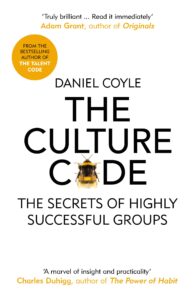
The Culture Code
Article #107
Why leaders who show vulnerability build stronger teams than leaders who project invincibility
The Culture Code by Daniel Coyle is the most compelling case study-driven treatment of how vulnerability loops — cycles of genuine admission met with genuine response — build the safety and cohesion that produce high-performing teams. Coyle's documentation of how the Navy SEALs, Pixar, and championship sports teams create belonging and performance through deliberate vulnerability practices is the applied evidence base for the mechanisms this article describes. His concept of the vulnerability loop — where one person's genuine admission of uncertainty or mistake creates the condition for another's, building a cumulative culture of safety — gives the research a concrete operational form. For any entrepreneur who understands the mechanisms intellectually and wants to know specifically what to do in a team meeting, a one-to-one conversation, or a difficult decision moment, this book provides the most directly actionable available account of what building a high-trust team actually looks and feels like from the inside.
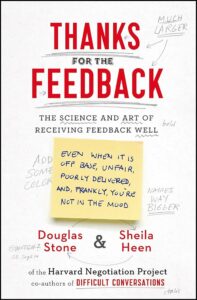
Thanks for the Feedback
Article #106
The psychology of feedback — why most performance reviews actually decrease performance
Thanks for the Feedback by Douglas Stone and Sheila Heen is the most practically grounded available treatment of why feedback fails and what can be done about it. Stone and Heen's three-trigger framework — truth triggers, which fire when the feedback feels factually wrong; relationship triggers, which fire when the relationship with the person giving feedback contaminates the reception of it; and identity triggers, which fire when the feedback threatens the recipient's sense of who they are — maps directly onto the FIT self-level attention mechanism and the ego threat research this article draws on. Their research on how different people's identity stability determines their vulnerability to the identity trigger is particularly useful for any entrepreneur managing a team with varying levels of psychological resilience. The book is rigorous without being inaccessible, and it provides the most direct available translation of the Kluger and DeNisi framework into management behaviour that can be changed on Monday morning.
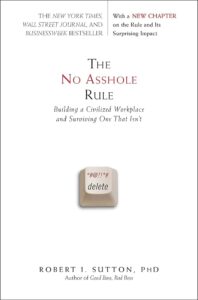
The No Asshole Rule
Article #105
Why one toxic team member reduces collective performance by up to 40% (The bad apple effect)
The No Asshole Rule by Robert Sutton is the most widely read applied treatment of the bad apple phenomenon and the most honest available reckoning with its commercial costs. Sutton's total cost of assholes framework — which attempts to quantify the full financial impact of one persistently hostile team member across turnover, reduced productivity, management time, and psychological damage — extends the Felps et al. research into a practical business case that is difficult to dismiss. His documentation of why bad apples survive in organisations despite their obvious costs — seniority, specialist knowledge, fear of conflict, ambiguity about what constitutes toxic behaviour — is the most useful available treatment of the gap between what organisations know and what they do. For any entrepreneur who has been aware of a team toxicity problem and delayed addressing it, this book provides both the evidence for why delay is costly and the framework for acting on it.
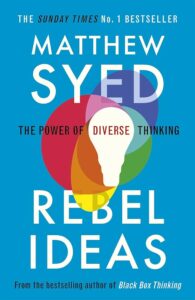
Rebel Ideas
Article #104
How cognitive diversity in teams produces better results but more conflict
Rebel Ideas by Matthew Syed is the most accessible applied synthesis of the cognitive diversity research programme available. Syed draws on the same BCG data, the same elaboration model, and the same task-versus-relationship conflict distinction to build a practical case for why organisations that select for agreement — that surround their leaders with people who think similarly — are making one of the most expensive strategic errors available. His treatment of echo chambers, marginal revolutionaries, and the specific failure modes of cognitively homogeneous teams is both rigorously grounded and immediately recognisable to anyone who has watched a founding team converge too quickly on a bad idea. For any entrepreneur building their first leadership team, it is the most directly actionable starting point available on this specific question.

The Human Side of Enterprise
Article #103
Why micromanagers create the exact outcomes they're trying to prevent
The Human Side of Enterprise by Douglas McGregor is the foundational text for the central argument of this article, and one of the most important management books ever written. McGregor's original case in 1960 — that management style does not respond to employees, it creates them — remains the clearest and most rigorous available account of why the assumptions a leader holds about human motivation become self-fulfilling through the management behaviour those assumptions generate. His Theory X and Theory Y distinction is not a typology of employees. It is a typology of what different management approaches produce in the same employees. For any entrepreneur who has found themselves tightening oversight in response to declining quality and wondering why the quality keeps declining, this book provides the most direct and most honest explanation of what is actually happening. It was written sixty-five years ago and describes most modern organisations with uncomfortable precision.
The Power Paradox
Article #102
How power changes your brain chemistry and makes you worse at empathy
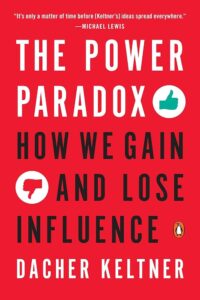
The Power Paradox by Dacher Keltner is the primary source for the twenty-year research programme this article draws on, and the most directly relevant single text available on this subject. Keltner writes with unusual honesty about what his own decades of research revealed — that the people most likely to acquire power are those with the greatest social and empathic capacity, and that those same people are then systematically pushed away from those capacities by the very power they earned. The book covers the neurological findings, the mirroring suppression research, the empathy deficit studies, and the accountability antidote in a way that is both rigorously grounded and genuinely readable. For any entrepreneur who has noticed themselves becoming less curious about others, less willing to update on feedback, or less attuned to the emotional states of the people around them — and who wants to understand why that might be happening and what can actually be done about it — this is the most direct and most honest starting point available.
The Positive Power of Negative Thinking
Article #101
Why the best leaders allow themselves to be anxious — the paradox of productive worry
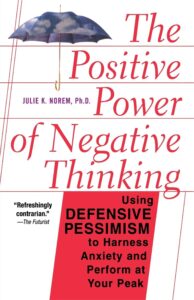
The Positive Power of Negative Thinking by Julie Norem is the book-length treatment of defensive pessimism by its originator — the most comprehensive and accessible account of when and why allowing negative thinking and anxiety produces better outcomes than positive reframing. Norem draws on her decades of research to demonstrate that the cognitive strategy most of us are told to abandon — imagining what could go wrong, sitting with worry, refusing to force optimism — is for a significant subset of people the strategy most closely associated with high performance, good preparation, and psychological wellbeing. For any entrepreneur who has always found positive visualisation hollow or counterproductive, this book offers both the research explaining why that might be rational and the most honest available treatment of the conditions under which worry is a strength rather than a weakness to be overcome.

The Fearless Organisation
Article #100
Why psychological safety is the single best predictor of team performance (Google's Project Aristotle)
The Fearless Organisation by Amy Edmondson is the definitive applied treatment of the psychological safety research programme and the most important single text an entrepreneur can read before hiring their first team. Edmondson moves from the foundational research — including the hospital nursing studies, the Columbia disaster analysis, and the Project Aristotle findings — into a concrete operational framework for building psychological safety deliberately rather than hoping it emerges. Her learning zone matrix, her three-cluster leadership behaviour model, and her case studies across industries all give the research a practical resolution that academic papers alone cannot provide. For any entrepreneur who wants to understand not just why psychological safety matters but specifically what to do on Monday morning to build it, this is where to start. The book also addresses the question Edmondson takes most seriously: how to hold both high safety and high standards simultaneously, which is the precise tension that most management frameworks fail to resolve.
Your Brain at Work
Article #99
How your leadership style triggers specific neurological responses in your team's brains
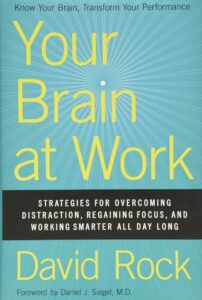
Your Brain at Work by David Rock is the most directly applicable treatment of the SCARF model for anyone managing people. Rock's extension of the framework into everyday workplace decisions — feedback conversations, team dynamics, performance management — is the most actionable available account of how neuroscience translates into leadership behaviour that can be changed deliberately.
Give and Take
Article #98
The psychology behind why asking for advice makes people respect you more, not less
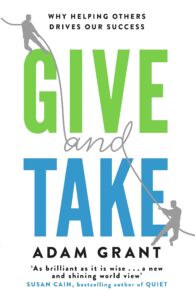
Give and Take by Adam Grant is the most research-grounded treatment of why asking for help — including advice — is the behaviour most strongly associated with long-term influence in professional relationships. Grant's research on how givers, matchers, and takers differ in their long-term trajectories directly predicts that advice-seeking, by activating the giver's tendency to invest, builds relational capital that compounds over time in ways that neither transactional exchange nor performed self-sufficiency can replicate
Rocket Fuel
Article #97
How the pioneer paradox means the person who builds a business is rarely the person who should run it at scale
Rocket Fuel by Gino Wickman and Mark Winters is the most practical treatment of the visionary/integrator split as a structural resolution to the pioneer paradox. Their documentation of real company cases where founders retained genuine influence through a redefined role — while an integrator handled operational execution — offers the most concrete available account of what the resolution looks like in practice rather than in theory.
No books found matching your search.